A TOEFL 2026 academic talk lasts between 45 and 120 seconds, about 100 to 250 words, and you hear it exactly once with no replay button.1Reach120TOEFL 2026 Listening Section: Complete GuideOpen source ↗Jump to footnote2ArnoTOEFL Listen to an Academic Talk: Complete Guide (TOEFL 2026 New Format)Open source ↗Jump to footnote The questions are not on screen while it plays. They appear after the audio finishes, so there is no question to read ahead and no phrase to match against.3Reach120TOEFL Academic Talks and Conversations: Listening Strategies 2026Open source ↗Jump to footnote4TestSucceedTOEFL 2026 Listening Task 3: Announcements and Academic TalksOpen source ↗Jump to footnote
That one design choice is what makes this the hardest of the four Listening tasks. Everything you will be asked has to survive the gap between the last word of the talk and the first question, carried by your notes and your memory. Test-takers who did well on the old TOEFL lectures often score lower here, because five minutes of lecture gave them room to recover from a lapse and ninety seconds does not.
What follows is the format, how the four points are awarded, and a note system built for a talk this short. For the whole-exam picture, start with the TOEFL 2026 test format guide.
What you see on test day
Listening is the second section of the 2026 test, and ETS lists it at 47 items in 29 minutes, with the caveat that "as the test adapts, test time and items may vary."5ETS OfficialTOEFL iBT Test Content: A Breakdown of Test SectionsOpen source ↗Jump to footnote Four task types share those items: Listen and Choose a Response, Listen to a Conversation, Listen to an Announcement, and Listen to an Academic Talk.5ETS OfficialTOEFL iBT Test Content: A Breakdown of Test SectionsOpen source ↗Jump to footnote Estimates of how many of those items are academic talks land around 8 to 16.2ArnoTOEFL Listen to an Academic Talk: Complete Guide (TOEFL 2026 New Format)Open source ↗Jump to footnote
The section runs as two adaptive modules, meaning a first part everyone takes (the router) followed by an easier or harder second part chosen from how you did, and roughly 60 percent accuracy in the router is the reported cutoff for the harder path.6TestSucceedTOEFL 2026 Listening and Reading Updates: How the New Adaptive Routing WorksOpen source ↗Jump to footnote The gap between the paths is wide: the harder module tops out at 6 of 6 on the band scale while the easier one tops out at 4, and the easier module drops academic talks in favor of everyday content.6TestSucceedTOEFL 2026 Listening and Reading Updates: How the New Adaptive Routing WorksOpen source ↗Jump to footnote Meeting an academic talk in your second module is therefore good news about your router performance.
ETS describes the task itself in one line: "You will listen to a short academic talk given by a professor or expert."7ETS OfficialTOEFL iBT Listening SectionOpen source ↗Jump to footnote On screen you get a short context sentence, an audio player, and nothing else while the talk runs. You can take notes, which ETS states explicitly, and the speaker may use any of the native-speaker accents from North America, the U.K., New Zealand, or Australia.7ETS OfficialTOEFL iBT Listening SectionOpen source ↗Jump to footnote Because the talk has a single speaker, an accent you find hard affects the entire clip rather than half the lines.
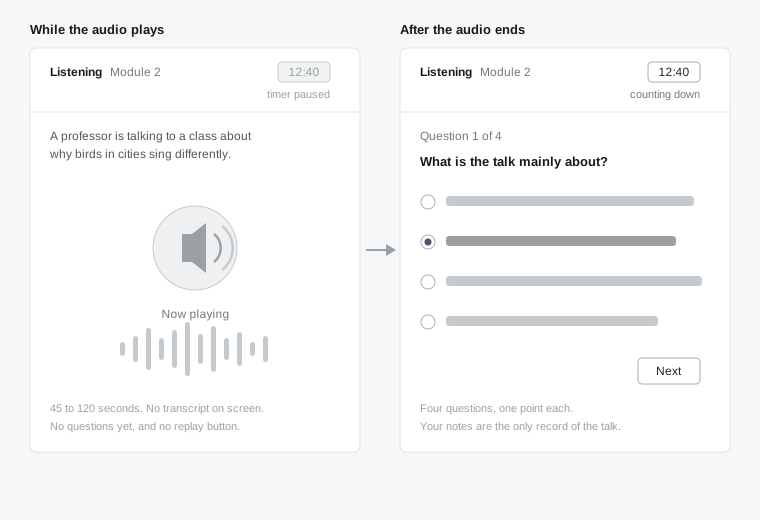
One detail changes how you should pace the whole section: the module timer counts down only while you are answering questions, not while audio is playing.6TestSucceedTOEFL 2026 Listening and Reading Updates: How the New Adaptive Routing WorksOpen source ↗Jump to footnote Listening time is free time. Nothing is gained by hurrying your attention during the talk, and the pacing pressure you feel belongs entirely to the 20 to 30 seconds you should be spending on each question afterward.4TestSucceedTOEFL 2026 Listening Task 3: Announcements and Academic TalksOpen source ↗Jump to footnote
Sources disagree slightly on how many questions follow each talk. Most prep guides report four, while at least one describes a range of two to four depending on the clip.1Reach120TOEFL 2026 Listening Section: Complete GuideOpen source ↗Jump to footnote3Reach120TOEFL Academic Talks and Conversations: Listening Strategies 2026Open source ↗Jump to footnote4TestSucceedTOEFL 2026 Listening Task 3: Announcements and Academic TalksOpen source ↗Jump to footnote ETS publishes the task description but no per-task count, so prepare for four and treat fewer as a bonus.7ETS OfficialTOEFL iBT Listening SectionOpen source ↗Jump to footnote5ETS OfficialTOEFL iBT Test Content: A Breakdown of Test SectionsOpen source ↗Jump to footnote
What Listen to an Academic Talk really tests
ETS says the task "measures your ability to understand main ideas, supporting details, organization, inferences, and sometimes uncommon or idiomatic vocabulary."7ETS OfficialTOEFL iBT Listening SectionOpen source ↗Jump to footnote The word doing the most work in that sentence is organization.
The underlying skill is holding the shape of an argument in your head while new sentences keep arriving. A ninety-second talk usually contains one claim, one mechanism (how it works), one example, and one complication, and the questions are spread across those four slots rather than concentrated on facts. If your notes record what was said but not how the pieces connect, you will answer the detail question and lose the function and inference questions (the ones that ask why something was said, and what it points to), which is the classic two-out-of-four pattern.
The second skill is recovery speed. Somewhere in most talks there is a word you do not know. Talks are set across a wide difficulty range, roughly CEFR A2 to C2, so hitting something above your level is expected rather than a sign of trouble.2ArnoTOEFL Listen to an Academic Talk: Complete Guide (TOEFL 2026 New Format)Open source ↗Jump to footnote What matters is whether you catch up within one sentence or spend fifteen seconds rebuilding the one you lost.
Background knowledge is not being tested. A psychology student hearing a psychology talk has no advantage, and can be hurt by one, because an answer choice that is true in the field but absent from the audio starts to feel like something they heard.
How Listen to an Academic Talk is scored
Every question is machine scored multiple choice, worth a maximum of one point, with no partial credit and no penalty for guessing wrong.2ArnoTOEFL Listen to an Academic Talk: Complete Guide (TOEFL 2026 New Format)Open source ↗Jump to footnote4TestSucceedTOEFL 2026 Listening Task 3: Announcements and Academic TalksOpen source ↗Jump to footnote A blank scores exactly what a wrong answer scores, so leaving one empty throws away a free 25 percent.
Your raw correct count across the whole section, combined with the difficulty of the module you were routed into, becomes a Listening band score from 1.0 to 6.0, reported in half-point steps and mapped to the CEFR.8ETS OfficialTOEFL Score Scale UpdateOpen source ↗Jump to footnote Your overall TOEFL score is "the average of the four section scores, rounded to the nearest half band."8ETS OfficialTOEFL Score Scale UpdateOpen source ↗Jump to footnote For two years after January 2026, score reports show the CEFR level, the 1 to 6 band, and a comparable 0 to 120 total side by side.8ETS OfficialTOEFL Score Scale UpdateOpen source ↗Jump to footnote5ETS OfficialTOEFL iBT Test Content: A Breakdown of Test SectionsOpen source ↗Jump to footnote
Two consequences follow. Four questions hang off a single ninety-second clip, so a lapse in concentration costs four points at once, while the same lapse during a Listen and Choose a Response item costs one.2ArnoTOEFL Listen to an Academic Talk: Complete Guide (TOEFL 2026 New Format)Open source ↗Jump to footnote And because academic talks appear in the router and then dominate the harder module, accuracy on the first talk you meet is worth more than its four points suggest.6TestSucceedTOEFL 2026 Listening and Reading Updates: How the New Adaptive Routing WorksOpen source ↗Jump to footnote
The strategy, step by step
Set up the page before the audio starts
Read the context sentence, because it names the field and often the specific topic, which is enough to bring to mind the vocabulary you are about to need. Then divide your note space into two narrow columns, one for terms and one for what the speaker does with them. Doing this in the seconds before the audio begins costs nothing, since the timer is not running yet.6TestSucceedTOEFL 2026 Listening and Reading Updates: How the New Adaptive Routing WorksOpen source ↗Jump to footnote
Get the topic down in the first fifteen seconds, then stop writing prose
Academic talks nearly always state their subject in the opening two sentences, sometimes after an opening question meant to pull you in.3Reach120TOEFL Academic Talks and Conversations: Listening Strategies 2026Open source ↗Jump to footnote Write it in two or three words at the top of your notes and underline it. That line answers the main idea question later, and having it on paper means you are not still hunting for the topic while the speaker moves to the mechanism.
Track why, not what
For every example, name, number, or study the speaker mentions, write one word for the thing and one word for its job: "traffic > masks song", "females > prefer low". Function questions ("Why does the professor mention Y?") are the ones people lose, and they are impossible to reconstruct from a list of nouns.3Reach120TOEFL Academic Talks and Conversations: Listening Strategies 2026Open source ↗Jump to footnote The job label is what you will actually read back.
Mark transitions with an arrow and keep listening
When the speaker turns a corner, signaled by words like "but", "so", "now", or "the interesting part is", draw an arrow and move on. Do not write the transition phrase itself. Two or three arrows across ninety seconds give you the outline of the talk, which is what the organization questions ask about, at a cost of half a second each.
Let a lost phrase go
If you miss something, mark a dash and stay with the audio. The next sentence almost always clarifies the one you lost, and going back for it in your head costs you the following two as well. This is the most expensive habit in the section, and being a habit rather than a skill gap, you can train it out in about a week.
After the audio, answer the main idea question first
Questions can be worked in any order within the module, so take the main idea item while the shape of the talk is fresh, using your underlined topic line.6TestSucceedTOEFL 2026 Listening and Reading Updates: How the New Adaptive Routing WorksOpen source ↗Jump to footnote Detail questions come next, since your notes either have the answer or they do not. Leave inference and function questions for last, where a second pass over your arrows genuinely helps. Budget 20 to 30 seconds per question and hold to it.4TestSucceedTOEFL 2026 Listening Task 3: Announcements and Academic TalksOpen source ↗Jump to footnote
Common academic talk mistakes and how to fix them
Writing full sentences. Over-noting is the most reported failure on this task, and the mechanism is simple: while you write a sentence, you are not listening, and the talk does not wait.2ArnoTOEFL Listen to an Academic Talk: Complete Guide (TOEFL 2026 New Format)Open source ↗Jump to footnote Cap yourself at four words per line for two weeks of practice and the notes will get more useful, not less.
Freezing on an unknown word. One unfamiliar term stalls some test-takers for the rest of the clip. Talks are written across a wide difficulty band on purpose, and the questions rarely hinge on the hardest noun in the audio.2ArnoTOEFL Listen to an Academic Talk: Complete Guide (TOEFL 2026 New Format)Open source ↗Jump to footnote Mark it and move.
Treating "Why does the speaker mention X?" as a detail question. The answer is almost never what X is. It is what X was doing there: illustrating a claim, marking a contrast, showing a limit. If your notes have only the noun, you are choosing between four plausible-sounding purposes with nothing to check them against.3Reach120TOEFL Academic Talks and Conversations: Listening Strategies 2026Open source ↗Jump to footnote
Practicing with old TOEFL lectures. Pre-2026 material trains you for a long lecture with repetition built in, where a missed point comes back around. A ninety-second talk states most things once, so the old length builds a pace of attention that is too relaxed for the current task.
Answering from what you already know. In a talk about a subject you have studied, the wrong choices that feel most reasonable are the ones true in the field but never spoken in the audio. Before selecting, ask whether you heard it or merely believe it.
A worked example
Here is a talk at the length you should expect, followed by the four questions and the thinking behind each.
Here is something you can test on your next walk. If you live in a city, listen to the birds outside your window, then listen to the same species an hour outside town. They often do not sound alike.
Researchers working with great tits in European cities found that urban birds sing at a noticeably higher pitch than rural ones. The cause is traffic. Road noise sits mainly at low frequencies, so a low song gets buried in it, and a male whose song cannot be heard does not attract a mate. Over generations, the higher singers are the ones that reproduce.
But that shift comes at a cost. Female great tits generally prefer lower songs, because a low song signals a larger body. So urban males are pushed toward a song that carries through the noise and is less attractive once it arrives.
The same pattern turns up in several other species, which suggests we are looking at a general response to noise rather than something peculiar to one bird.
Your notes, at four words a line, might read: city birds sing higher / traffic = low freq, masks / unheard male > no mate / → cost: females prefer low / low = big body / → other species too = general.
What is the talk mainly about? Answer from the underlined top line before anything else. The correct choice will say something close to "how urban noise has changed the songs of some birds." The trap option is usually narrower than the talk, for example one about how female great tits choose mates, which got twelve seconds of airtime as a supporting point.
According to the speaker, why is a low-pitched song a disadvantage in cities? Straight from the second note line: traffic noise occupies the low frequencies and masks it. Watch for a choice saying low songs are harder for birds to produce in cities, which sounds plausible and was never said.
Why does the speaker mention that females prefer lower songs? Your arrow line already answers it: to show the cost that comes with the adaptation. A choice explaining what low pitch signals about body size is true, appeared in the audio, and is still wrong, because the question asks about purpose rather than content. This is the item that separates scores here.
What can be inferred about great tits living in quiet rural areas? Nothing states this outright, which is the signal to combine two lines: females prefer low songs, and only city noise pushes males higher. The safe inference is that rural males with lower songs do well with females. Any choice claiming rural birds cannot be heard in cities goes further than two lines can carry you.
How to study for TOEFL academic talks
The trainable skill here is understanding a short, dense, unfamiliar talk on one hearing. Fifteen minutes a day moves it faster than running full practice sections does.
The one-listen summary. Take any ninety-second stretch of a podcast or lecture clip, listen once with your two-column notes, then say aloud without looking: the topic, the mechanism, one example, and the reason that example was there. Check against a replay. Ten minutes a day for two weeks, and never replay more than once.
The function-labeling drill. Take a transcript of something you have already heard and write a two-word job label beside each sentence: "sets up problem", "gives evidence", "admits a limit". Five minutes, twice a week. It is the fastest fix for function questions.
Dictation, in small doses. Once or twice a week, transcribe thirty seconds of audio word for word. It is slow and worth it, because it exposes which sounds your ear drops, usually unstressed function words rather than the vocabulary you assume is the problem.
Rotate accents deliberately. Since the audio can come from four accent regions, spend one session a week each on British, Australian, and New Zealand sources rather than defaulting to American English.7ETS OfficialTOEFL iBT Listening SectionOpen source ↗Jump to footnote
A three-week outline that fits around other prep:
- Week 1: notes without a clock. One talk a day, no timing pressure, and after each one rewrite your notes from memory into the four-slot shape of claim, mechanism, example, complication. Compare with the transcript. You are training the notes, not the score.
- Week 2: one hearing only. Same volume, but no replays before you answer and no pausing. Accuracy usually dips for a few days and then recovers above where it started.
- Week 3 onward: sequence and fatigue. Do a talk immediately after two conversations and an announcement, with no break, so you practice reaching the heaviest task with your attention already spent. Once a week, run the full Listening section inside a mock test.
Without an AI grading you, self-evaluate on one number: how many of the four slots you can name after a single listen, before you look at any question. Consistently getting three or four means your remaining errors live in the answer choices rather than in the listening, so shift your practice toward reading options carefully.
How to practice this on FluentPrep AI
The Listen to an Academic Talk practice mode runs the task in test shape: a context line, audio that plays without a transcript, and four questions that appear only once the talk has finished. Talks span life science, physical science, history, art and music, business and economics, psychology, and sociology, organized into numbered tests with a score for each one, and new talks are added regularly. Each question is marked right or wrong as soon as you answer, with the correct choice revealed before you move on.
Get more from it with two house rules. Keep paper next to you and take real notes, because practicing this task by staring at the screen trains a habit you cannot use on test day. And before you look at question 1, say the four slots out loud from your notes; when a question you got wrong turns out to be about a slot you could not name, the fix is in your listening rather than in your reading of the options. Once a single talk feels comfortable, run three in a row alongside Listen to a Conversation to build the endurance the real module demands. All twelve tasks sit together on the practice hub.
Where to go from here
Tonight, find any ninety-second clip of someone explaining something, listen once, and write down four things: the claim, the mechanism, the example, and the complication. If you can only fill three slots, that gap is your score. Tomorrow, do one academic talk on FluentPrep AI with paper, one hearing, and no pausing, then move to Listen to an Announcement, where the same note discipline earns points in half the time.
Footnotes
-
Reach120. "TOEFL 2026 Listening Section: Complete Guide". Accessed 2026-09-07. ↩ ↩2
-
Arno. "TOEFL Listen to an Academic Talk: Complete Guide (TOEFL 2026 New Format)". Accessed 2026-09-07. ↩ ↩2 ↩3 ↩4 ↩5 ↩6 ↩7
-
Reach120. "TOEFL Academic Talks and Conversations: Listening Strategies 2026". Accessed 2026-09-07. ↩ ↩2 ↩3 ↩4 ↩5
-
TestSucceed. "TOEFL 2026 Listening Task 3: Announcements and Academic Talks". Accessed 2026-09-07. ↩ ↩2 ↩3 ↩4 ↩5
-
ETS Official. "TOEFL iBT Test Content: A Breakdown of Test Sections". Accessed 2026-09-07. ↩ ↩2 ↩3 ↩4
-
TestSucceed. "TOEFL 2026 Listening and Reading Updates: How the New Adaptive Routing Works". Accessed 2026-09-07. ↩ ↩2 ↩3 ↩4 ↩5 ↩6
-
ETS Official. "TOEFL iBT Listening Section". Accessed 2026-09-07. ↩ ↩2 ↩3 ↩4 ↩5
-
ETS Official. "TOEFL Score Scale Update". Accessed 2026-09-07. ↩ ↩2 ↩3