The TOEFL 2026 Listen to a Conversation task gives you a campus dialogue of about 30 to 90 seconds, roughly ten turns between two speakers, and then two multiple-choice questions that you do not see until the audio has stopped.1Reach120TOEFL 2026 Listening Section: Complete GuideOpen source ↗Jump to footnote2TestSucceedTOEFL 2026 Listening Task 2: ConversationsOpen source ↗Jump to footnote There is no replay.3ArnoTOEFL Listen to a Conversation: Complete Guide (TOEFL 2026 New Format)Open source ↗Jump to footnote
Ten of the 47 items in the Listening section come from this task, and ETS targets it at CEFR A2 to C1.4ETS OfficialTOEFL iBT Test: 2026 Update Test Blueprint and Specifications DocumentOpen source ↗Jump to footnote That C1 ceiling is where people lose points. The lower-level items ask what a speaker said; the upper-level ones ask what a speaker meant, which is a different skill and one that almost nobody practices on purpose.
The good news is that campus conversations are among the most predictable audio on the test, because they nearly all follow the same shape. For the whole-exam picture, start with the TOEFL 2026 test format guide.
What you see on test day
Listening has 47 items in about 29 minutes of base time, and like Reading it runs as a two-stage adaptive test: an 18-minute router everyone takes, then a second module of 7 minutes if you are routed lower or 11 minutes if you are routed upper.4ETS OfficialTOEFL iBT Test: 2026 Update Test Blueprint and Specifications DocumentOpen source ↗Jump to footnote1Reach120TOEFL 2026 Listening Section: Complete GuideOpen source ↗Jump to footnote Item totals include non-scored questions that ETS uses to gather data for future test versions, so not every answer you give counts.4ETS OfficialTOEFL iBT Test: 2026 Update Test Blueprint and Specifications DocumentOpen source ↗Jump to footnote
ETS describes this task in one line: "You will listen to a conversation primarily related to campus life," measuring "your understanding of main ideas, key details, speaker intent, and implied meaning."5ETS OfficialTOEFL iBT Listening SectionOpen source ↗Jump to footnote The speakers are usually a student with a professor, an advisor, or campus staff, and sometimes two students; the topics run to scheduling, deadlines, facilities, and the practical side of coursework.1Reach120TOEFL 2026 Listening Section: Complete GuideOpen source ↗Jump to footnote2TestSucceedTOEFL 2026 Listening Task 2: ConversationsOpen source ↗Jump to footnote
While the audio plays there is nothing on screen but a player. The questions appear only after the conversation ends, so there is no stem to read ahead of time and no answer choice to match against as you listen.2TestSucceedTOEFL 2026 Listening Task 2: ConversationsOpen source ↗Jump to footnote3ArnoTOEFL Listen to a Conversation: Complete Guide (TOEFL 2026 New Format)Open source ↗Jump to footnote You can take notes throughout: ETS says explicitly that "you can take notes while listening to help you answer the questions."5ETS OfficialTOEFL iBT Listening SectionOpen source ↗Jump to footnote ETS also warns that the voices may carry "native-speaker English accents from North America, the U.K., New Zealand, or Australia."5ETS OfficialTOEFL iBT Listening SectionOpen source ↗Jump to footnote
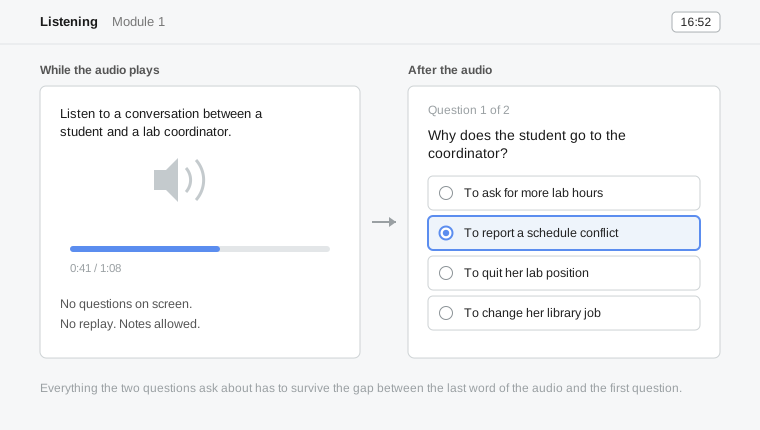
This is a large change from the pre-2026 test, which used two long conversations carrying five questions each inside a 36-minute section.6TypoGrammarOld TOEFL vs New TOEFL 2026: Every Change ExplainedOpen source ↗Jump to footnote Five questions on one conversation meant a missed line cost you part of a set. Two questions on a 60-second dialogue means a missed line can cost you the whole set.
What Listen to a Conversation really tests
The ETS blueprint files this task under understanding "short conversations between two people" in a social interpersonal language context, which is a different kind of skill from the academic listening in the same section.4ETS OfficialTOEFL iBT Test: 2026 Update Test Blueprint and Specifications DocumentOpen source ↗Jump to footnote What that means in practice is that the audio is practical: someone wants something, something is in the way, and the two speakers work out what to do.
Almost every campus conversation on this test has the same four beats: a reason for the conversation in the opening lines, a complication, one or more proposals, and a resolution with an action attached. Once you hear that shape, you stop trying to remember sentences and start filling in four slots, which is a far lighter load on a working memory that has to survive until the questions appear.
The second skill is pragmatic, meaning it is about what a speaker means rather than the exact words, and it is what separates the A2 items from the C1 ones. "I could do Thursday, I suppose" and "Thursday works" carry the same information and different attitudes, and the harder questions ask about the attitude. Test-takers with strong academic English but limited exposure to spoken negotiation tend to hear the literal content, miss the hedging (the soft, indirect way people avoid saying no), and then pick an answer that is true about the words and wrong about the speaker.
How Listen to a Conversation is scored
Every question is machine scored multiple choice worth a maximum of one point, with no partial credit, so an answer is either right or wrong with nothing for being close.3ArnoTOEFL Listen to a Conversation: Complete Guide (TOEFL 2026 New Format)Open source ↗Jump to footnote4ETS OfficialTOEFL iBT Test: 2026 Update Test Blueprint and Specifications DocumentOpen source ↗Jump to footnote ETS defines machine-scored item types as ones evaluated with "rule-based algorithms" on selected responses, "based on exact matches or predefined scoring logic," so no AI is judging your listening the way one judges your Speaking.4ETS OfficialTOEFL iBT Test: 2026 Update Test Blueprint and Specifications DocumentOpen source ↗Jump to footnote There is no penalty for a wrong guess, which makes an unanswered question the only choice with a guaranteed cost.
Your correct answers across all four Listening task types, together with the difficulty of the module you were routed into, produce a Listening band from 1.0 to 6.0 in half-point steps and aligned to the CEFR, and your overall score is the average of the four section bands rounded to the nearest half band.7ETS OfficialTOEFL Score Scale UpdateOpen source ↗Jump to footnote
Two structural facts should shape how you spend your effort. This task supplies only 10 of the 47 Listening items, so each conversation is worth about a fifth of the task's total and a single lost dialogue is expensive.4ETS OfficialTOEFL iBT Test: 2026 Update Test Blueprint and Specifications DocumentOpen source ↗Jump to footnote And the router decides your ceiling: conversations appear in the router alongside the other three task types, roughly 60 percent accuracy there is the reported threshold for the harder second module, and the harder path tops out at 6 of 6 on the band scale while the easier one tops out at 4.8TestSucceedTOEFL 2026 Listening and Reading Updates: How the New Adaptive Routing WorksOpen source ↗Jump to footnote The conversations you meet early are worth more than their point value suggests.
The strategy, step by step
Set up your page before you press play, and never rush the audio
The module timer counts down only while you are answering questions, not while audio is playing.8TestSucceedTOEFL 2026 Listening and Reading Updates: How the New Adaptive Routing WorksOpen source ↗Jump to footnote Listening costs you nothing, so the pressure you feel during the dialogue is imaginary and the pressure you feel afterward is real. Use the free seconds before the audio starts to draw your two columns and read the context line naming the speakers.
Fix the two roles before the second turn ends
The opening lines tell you who the speakers are and why they are talking, and the main-purpose question is answered there. Write two labels at the top of your note area (S for student, C for coordinator, P for professor) and commit to them immediately. If you are still deciding who is who at the thirty-second mark, you are spending memory on bookkeeping instead of content.
Split the page into two columns, one per speaker
A single-column note turns a dialogue into a transcript, and a transcript is the one thing you cannot produce in real time. Two columns force you to record who wanted what, which is what the questions ask about. Under each speaker, write only what they want, what they propose, and what they refuse.
Listen for the pivot words
The turn where the plan changes is almost always marked: "actually," "the thing is," "unfortunately," "what I can do is." When you hear one, put an arrow in your notes. That arrow is where the correct answer to the second question usually lives, because the earlier proposals become the distractors (wrong choices written to look right).
Mark attitude, not just content
A plus, a minus, or a question mark next to a proposal costs you nothing and captures the meaning behind the words, which the C1 items test. Reluctant agreement, polite refusal, and genuine enthusiasm all sound different, and none of them survive in a note that records only the words.
Predict the two questions before they appear
In the seconds between the last word and the first question, ask yourself why the conversation happened and what was decided. Those two answers cover most question pairs on this task, and having them formed before the options load stops a plausible wrong option from talking you out of what you actually heard.
Answer the purpose question first, then the detail
You can move back and forth between questions while the module is running, so order is yours to choose.8TestSucceedTOEFL 2026 Listening and Reading Updates: How the New Adaptive Routing WorksOpen source ↗Jump to footnote Take purpose first: it is the more reliable of the two, because it is decided in the opening lines, which is the part of the audio you heard with the freshest attention. Then come back to the detail question with your reading of the conversation already fixed.
Common mistakes and how to fix them
Trying to transcribe. Writing full sentences means you stop listening while you write, and in a 60-second dialogue that costs two or three turns.1Reach120TOEFL 2026 Listening Section: Complete GuideOpen source ↗Jump to footnote Fix it with a hard rule of at most four words per note, plus symbols.
Answering with the first plan instead of the final one. Campus conversations raise ideas that then get rejected, and those rejected ideas become answer choices precisely because you heard them said out loud. Fix it by treating every option that appeared early in the conversation as a suspect and checking it against your pivot arrow.
Hearing the words and missing the intent. "I guess I could move it" is agreement under protest, and questions about speaker attitude are built on that gap.5ETS OfficialTOEFL iBT Listening SectionOpen source ↗Jump to footnote Fix it by drilling indirect English on purpose rather than assuming exposure will cover it.
Losing track of who said what. Two speakers of the same gender, or an unfamiliar accent on one of them, and it blurs who said what. Fix it with the two-column note, which keeps the speakers separate for you instead of leaving it to memory.
Freezing on a missed word. One unfamiliar word costs you nothing; three seconds of trying to recover it costs you the next two turns and probably the resolution. Fix it by deciding in advance that you will let unknown words go past and rely on the shape of the conversation.
A worked example
Here is a conversation of the length and style to expect, at about 70 seconds.
Student: Hi, I'm supposed to start my lab shift on Monday, but I just found out my chemistry seminar got moved to Monday afternoons.
Coordinator: Ah. Is that the two-thirty seminar?
Student: Two-thirty to four. And my shift is one to four.
Coordinator: We can't split a shift, unfortunately. Thursday mornings are open, though, same number of hours.
Student: Thursday mornings I have my job at the library. Could I do Wednesday evenings instead?
Coordinator: The building closes at six on Wednesdays, so there'd be no supervisor. What I can do is put you on Thursday afternoons and let you make up the two extra hours on a Saturday.
Student: That's fine, actually. I'd rather keep the library shift.
Coordinator: Then I'll change it in the system today. Just email me by Friday to confirm.
Your notes, if the system is working, are about twelve words: S: Mon shift, seminar 2:30 clash. C: no split. Thu am? S: library. Wed pm? no supervisor. → Thu pm + Sat makeup. email by Fri.
Question 1. Why does the student go to the coordinator? The four options are asking for more lab hours, reporting a schedule conflict with a class, quitting her lab position, and changing her library job. This one was decided in the first eight seconds, and your top note line answers it: she has a conflict between her shift and a moved seminar. The library job appears in the conversation, which is what makes the last option tempting to anyone reconstructing from fragments rather than from the opening.
Question 2. What does the student agree to do? The options are work Thursday mornings, work Wednesday evenings with a supervisor, move to Thursday afternoons and make up hours on Saturday, or split the Monday shift. Three of those four were said out loud and rejected: the split is refused in the coordinator's first reply, Thursday mornings die on the library job, and Wednesday evenings die on the supervisor. Only the arrow in your notes points at the answer. This is the standard distractor design for this task, and it is why the pivot mark matters more than any other note you take.
Notice a third question was available and did not get asked: emailing by Friday. Action items are prime question material, so capture them even when you have already heard the resolution.
How to study for Listen to a Conversation
Predict-the-questions drill, ten minutes four times a week. Find any short two-person dialogue in English (a podcast interview segment, a scene from a show without subtitles, a service-desk exchange). Listen once, then write down the two questions you would ask about it and answer them. You are training the prediction habit that carries you across the gap between the audio and the question screen.
Two-column note drill, five minutes a day. Take the same audio and take notes in the two-column format, capping yourself at four words per line. Then check your notes against a second listen and count how many of the four beats you captured: reason, complication, proposals, resolution. Getting all four consistently is the goal, not writing more.
Indirect English collection, ongoing. Write down hedged phrases as you meet them, along with what they actually commit the speaker to. "I suppose that could work," "let me see what I can do," "I'd rather not, but." Twenty entries is enough to change what you hear in a negotiation, and this is the single most useful thing you can do for the C1 items.
Accent rotation, twice a week. Since ETS names British, Australian, and New Zealand accents alongside North American ones, spend some of your listening time deliberately outside your comfort accent.5ETS OfficialTOEFL iBT Listening SectionOpen source ↗Jump to footnote Ten minutes of unfamiliar-accent audio a week is enough to stop it being a shock.
Across three weeks, spend week one taking notes untimed with the transcript available afterward, so every miss can be traced to a specific line you did not catch. In week two, drop the transcript until after you have answered, and start logging misses in three buckets: missed the purpose, missed the resolution, missed the attitude. From week three, run mixed Listening modules that alternate conversations with academic talks, since the real section switches between social and academic listening without warning and the switch itself has a cost.
That three-bucket log is also how you grade yourself without an answer key in front of you. Mostly purpose misses means you are not committing to the roles fast enough; mostly resolution misses means your pivot marking is weak; mostly attitude misses means your problem is reading what people mean, not hearing the words, and no amount of extra audio will fix it on its own.
How to practice Listen to a Conversation on FluentPrep AI
Our Listen to a Conversation practice sets use two-speaker campus dialogues with two questions each, matching the shape and the question count of the real task, and questions stay hidden until the audio finishes so you get the same memory load the test creates. Each question is marked as soon as you answer, with the correct choice shown next to yours, and each conversation gets a score out of two so you can see at a glance whether you lost a full set or half of one. One difference from the real screen is worth using deliberately: there is a Replay Conversation button, which the real test does not give you. Treat it as a review tool rather than a crutch by answering both questions first, then replaying to find the exact line you missed, which is what turns a wrong answer into a fixed habit. The practice hub has the other three Listening tasks when you want to run a mixed module.
Where to go from here
Pick any two-person conversation you hear today, in English, and write down the four beats before you forget them: why they were talking, what got in the way, what was proposed, and what they settled on. Do that once a day for a week, then run a set of conversation practice with two questions each and see how much less you need to remember.
Footnotes
-
Reach120. "TOEFL 2026 Listening Section: Complete Guide". Accessed 2026-09-07. ↩ ↩2 ↩3 ↩4
-
TestSucceed. "TOEFL 2026 Listening Task 2: Conversations". Accessed 2026-09-07. ↩ ↩2 ↩3
-
Arno. "TOEFL Listen to a Conversation: Complete Guide (TOEFL 2026 New Format)". Accessed 2026-09-07. ↩ ↩2 ↩3
-
ETS Official. "TOEFL iBT Test: 2026 Update Test Blueprint and Specifications Document". Accessed 2026-09-07. ↩ ↩2 ↩3 ↩4 ↩5 ↩6 ↩7
-
ETS Official. "TOEFL iBT Listening Section". Accessed 2026-09-07. ↩ ↩2 ↩3 ↩4 ↩5
-
TypoGrammar. "Old TOEFL vs New TOEFL 2026: Every Change Explained". Accessed 2026-09-07. ↩
-
ETS Official. "TOEFL Score Scale Update". Accessed 2026-09-07. ↩
-
TestSucceed. "TOEFL 2026 Listening and Reading Updates: How the New Adaptive Routing Works". Accessed 2026-09-07. ↩ ↩2 ↩3