The hardest item in a TOEFL Read in Daily Life set is usually the last one, and the text it comes from is a café menu. You read forty words about breakfast specials, you understand every single word, and then two of the four answer choices look equally correct.
That gap between understanding the text and answering the question is what this task is built on. Read in Daily Life gives you short nonacademic texts (notices, emails, schedules, menus, invoices, social posts) of 15 to 150 words, followed by two or three multiple-choice questions.1College CouncilTOEFL 2026 Reading: Complete the Words, Read in Daily Life, and Academic PassageOpen source ↗Jump to footnote2PrepDrillsTOEFL Reading 2026: Question Types, Timing, PracticeOpen source ↗Jump to footnote3LingoLeapTOEFL Reading Section Guide 2026: Format, Question Types and StrategiesOpen source ↗Jump to footnote ETS targets it at CEFR levels A1 to C1, which makes it the most approachable reading task on the test.4ETS OfficialTOEFL iBT Test: 2026 Update Test Blueprint and Specifications DocumentOpen source ↗Jump to footnote It is also the worst place on the Reading section to drop a point.
Nearly every point lost here comes from one of five habits, and all five are trainable in about ten minutes a day. For the whole-exam picture first, read the TOEFL 2026 test format guide.
What you see on test day
Reading comes first in the 2026 test, and ETS lists the section at 50 items with about 30 minutes of base time.5ETS OfficialTOEFL iBT Test Content: A Breakdown of Test SectionsOpen source ↗Jump to footnote The blueprint breaks that time down further: Reading is a two-stage adaptive test made of a router of 18 to 21 minutes plus a second module of about 9 minutes.4ETS OfficialTOEFL iBT Test: 2026 Update Test Blueprint and Specifications DocumentOpen source ↗Jump to footnote Everyone takes the same router, and how accurately you answer it decides whether your second module is the upper or the lower one, with only the upper module reaching the top of the band scale.2PrepDrillsTOEFL Reading 2026: Question Types, Timing, PracticeOpen source ↗Jump to footnote1College CouncilTOEFL 2026 Reading: Complete the Words, Read in Daily Life, and Academic PassageOpen source ↗Jump to footnote You cannot return to the router once you submit it.1College CouncilTOEFL 2026 Reading: Complete the Words, Read in Daily Life, and Academic PassageOpen source ↗Jump to footnote
Read in Daily Life accounts for 5 to 15 of those 50 items, and it appears in both stages.4ETS OfficialTOEFL iBT Test: 2026 Update Test Blueprint and Specifications DocumentOpen source ↗Jump to footnote3LingoLeapTOEFL Reading Section Guide 2026: Format, Question Types and StrategiesOpen source ↗Jump to footnote Reading has 50 items but only 35 raw points, because ETS includes non-scored items that exist to gather data for future test versions.4ETS OfficialTOEFL iBT Test: 2026 Update Test Blueprint and Specifications DocumentOpen source ↗Jump to footnote Some of the questions in front of you do not count, and you cannot tell which, so do not try to keep score of your own performance mid-section.
Each set opens with a one-line instruction naming the text type, something like "Read a notice." The text sits on one side of the screen and the questions come one at a time beside it. ETS specifies that "all texts remain visible throughout the task," so nothing disappears when you move to question two.4ETS OfficialTOEFL iBT Test: 2026 Update Test Blueprint and Specifications DocumentOpen source ↗Jump to footnote Answer choices are four radio buttons, nothing in the text is highlighted for you, and you can move backward through the questions in your current module.1College CouncilTOEFL 2026 Reading: Complete the Words, Read in Daily Life, and Academic PassageOpen source ↗Jump to footnote
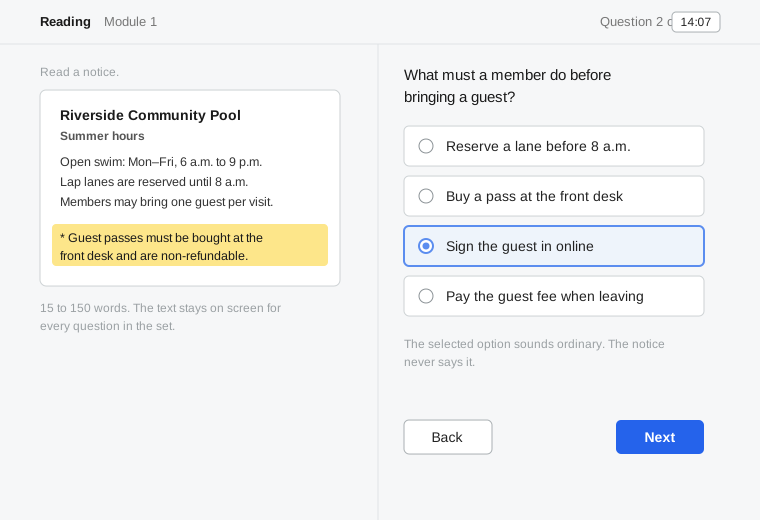
ETS names signs, menus, emails, and social media posts as examples of the everyday texts, and prep breakdowns of real forms add schedules, invoices, receipts, advertisements, and message chains.4ETS OfficialTOEFL iBT Test: 2026 Update Test Blueprint and Specifications DocumentOpen source ↗Jump to footnote1College CouncilTOEFL 2026 Reading: Complete the Words, Read in Daily Life, and Academic PassageOpen source ↗Jump to footnote6ArnoTOEFL Read in Daily Life: Complete Guide (TOEFL 2026 New Format)Open source ↗Jump to footnote Several of those are not written in full sentences at all, which matters more than it sounds.
What Read in Daily Life really tests
The subskill named in the ETS blueprint is "understand short non-academic written texts" in a social interpersonal language context, and the evidence statements underneath spell out what that covers: understanding information in common, non-linear text formats, identifying the main purpose of a short written communication, recognizing pronoun referents, understanding both prose and telegraphic language, understanding informal language including common idiomatic expressions, identifying a writer's purpose within a correspondence, scanning for details, skimming for main ideas, and making inferences about what is implied but not explicitly stated.4ETS OfficialTOEFL iBT Test: 2026 Update Test Blueprint and Specifications DocumentOpen source ↗Jump to footnote
Three of those do real damage to otherwise strong readers.
Non-linear and telegraphic text. "Non-linear" text is text you do not read straight through, like a menu, a schedule, or an invoice. "Telegraphic" means short note-style lines that drop small words, like "No entry after 6 p.m." Neither has topic sentences. Meaning lives in the layout: what sits under which heading, what the asterisk at the bottom changes, what the brackets after a price leave out. Readers trained on paragraphs go left to right and miss the connection the question asks about.
Writer's purpose inside a message. A notice about paperless billing is about billing, and its purpose is to get you to enroll. Those two answers sit in the same option list often enough that purpose questions have their own reliable trap.
Implied meaning in polite English. "I'd rather not, but I can ask" carries real information about what will happen next. Reading between the lines of an email or message is a comprehension skill, and it is the one that catches test-takers whose academic English is far stronger than their social English.
One disagreement in the prep literature is worth resolving before you practice. Some 2026 guides describe this task as purely literal and warn you against inferring anything.2PrepDrillsTOEFL Reading 2026: Question Types, Timing, PracticeOpen source ↗Jump to footnote ETS says the opposite: the questions "measure your understanding of main ideas, key details, and implied meaning," and the blueprint lists inference explicitly.7ETS OfficialTOEFL iBT Reading SectionOpen source ↗Jump to footnote4ETS OfficialTOEFL iBT Test: 2026 Update Test Blueprint and Specifications DocumentOpen source ↗Jump to footnote Follow ETS. But the inferences here, meaning conclusions the text points to without stating them, sit just one step from the text, so if your reasoning takes three sentences to explain, you have left the text behind.
How Read in Daily Life is scored
Every question is machine scored. ETS defines machine-scored item types as ones evaluated with "rule-based algorithms" on selected responses, "based on exact matches or predefined scoring logic," so no AI judges your reading the way one judges your Speaking and Writing.4ETS OfficialTOEFL iBT Test: 2026 Update Test Blueprint and Specifications DocumentOpen source ↗Jump to footnote Each question is worth a maximum of one point, there is no partial credit, and there is no penalty for a wrong answer.6ArnoTOEFL Read in Daily Life: Complete Guide (TOEFL 2026 New Format)Open source ↗Jump to footnote A blank scores exactly what a wrong guess scores, so leaving one empty is the one move that can only lose you points.
Your correct answers across all three Reading task types, together with the difficulty of the module you were routed into, produce a Reading band from 1.0 to 6.0 in half-point steps and aligned to the CEFR, and your overall score is the average of the four section bands rounded to the nearest half band.8ETS OfficialTOEFL Score Scale UpdateOpen source ↗Jump to footnote
The scoring detail that should change your behavior is the difficulty ceiling. Read in Daily Life is targeted at A1 to C1, while Read an Academic Passage runs B1 to C2.4ETS OfficialTOEFL iBT Test: 2026 Update Test Blueprint and Specifications DocumentOpen source ↗Jump to footnote The academic items are what separate the top scorers, so daily life items are points you are expected to hold rather than points that lift you. Treat a wrong answer on a 40-word notice as expensive, because nothing later in the section gives it back.
The strategy, step by step
Read prose texts in full, and only skim the non-linear ones
Most 2026 guides tell you to read the questions before the text.3LingoLeapTOEFL Reading Section Guide 2026: Format, Question Types and StrategiesOpen source ↗Jump to footnote6ArnoTOEFL Read in Daily Life: Complete Guide (TOEFL 2026 New Format)Open source ↗Jump to footnote1College CouncilTOEFL 2026 Reading: Complete the Words, Read in Daily Life, and Academic PassageOpen source ↗Jump to footnote That advice came from the era of 700-word passages, and on an email of 90 words it costs more than it saves: you read the questions, read the text, then reread the questions with no memory of what you just scanned for. A prose text in this range takes 25 to 40 seconds to read properly, and reading it once means you answer both questions from memory with a single verification pass.
Split the difference by text shape. Continuous prose, meaning ordinary sentences and paragraphs like an email, a notice, or a message chain, gets read whole, first. A table, schedule, menu, invoice, or form does not get read in the ordinary sense at all: take ten seconds to learn its structure, meaning what the columns are, where the totals sit, and what the fine print attaches to, then let the questions tell you which cell to look in.
Name the sender, the reader, and the ask
Before question one, say three things to yourself: who wrote this, who is supposed to read it, and what they want that reader to do. This takes four seconds and it answers the purpose question outright, which is the most common question type in the set.6ArnoTOEFL Read in Daily Life: Complete Guide (TOEFL 2026 New Format)Open source ↗Jump to footnote It also protects you from the topic-versus-purpose trap, because you stated the purpose in your own words before any option could suggest a different one.
Read the fine print before you read the questions
Asterisks, parentheses, footnotes, "except", "excluding", "upon receipt", the line set in smaller type at the bottom. Test writers put the tested exception there because that is where it lives in real documents. On a menu, the asterisked line is usually the answer to one of the two questions. Give it three seconds of deliberate attention rather than the glance you would give it in real life.
Answer in your own words before you look at the options
Cover the four choices mentally and answer the question yourself in a short phrase. Then look. The point here is protection, not speed: an option you have already answered in your own words cannot pull you in, and the distractor (a wrong choice written to look right) loses most of its pull when you arrive with an answer already formed.
Decide the final two on their small words
When two options survive, the difference between them is almost always one word, and that word is almost always a qualifier, meaning a small word that changes how strong a statement is: not, only, may, must, required, optional, all, any, unless, before, after.6ArnoTOEFL Read in Daily Life: Complete Guide (TOEFL 2026 New Format)Open source ↗Jump to footnote Put the two side by side, find the single word that differs in force, and go back to the text for that word specifically. The notice said members may bring a guest. The wrong option says members must register one. Everything else in that option is a faithful copy of the text, which is exactly why it reads so well.
Common mistakes and how to fix them
Swapping a qualifier without noticing. This is the most common way points are lost on this task. The wrong option copies the text exactly except for one small word that turns may into must, or "you can" into "you have to."6ArnoTOEFL Read in Daily Life: Complete Guide (TOEFL 2026 New Format)Open source ↗Jump to footnote Fix it by making the qualifier check a step you always run, not something you do only when you happen to notice it.
Answering the topic instead of the purpose. "What is the main purpose of the notice?" asks about the writer's goal. An option that summarizes the subject matter accurately, and says nothing about what the writer wants from you, is wrong even though every word in it is true. Fix it by finishing the sentence "the writer wrote this in order to..." before you read the choices.
Skipping the structural line. Footnotes, asterisks, and the exceptions tucked into brackets get skimmed because in daily life they are boring. Fix it by treating any line in the text that changes another line as a question waiting to happen.
Reading polite hedging as agreement. Hedging is soft, indirect language that avoids a direct no. "I guess we could try that place, if you really want to" is a refusal in disguise, and inference questions are built on exactly this gap between what is said and what is meant.1College CouncilTOEFL 2026 Reading: Complete the Words, Read in Daily Life, and Academic PassageOpen source ↗Jump to footnote Fix it by collecting the hedges you meet in real English and writing down what each one really commits the speaker to.
Reasoning past the text. Inference here means one step, not three. If your justification requires a fact the text never provides, you have built an answer instead of finding one. Fix it by requiring yourself to point at the words that support your choice; if you cannot quote them, eliminate rather than choose.
A worked example
Instruction: Read a chain of text messages.
Priya: Locksmith can come Thursday between 12 and 4. Any chance you're around?
Daniel: Thursday's my clinic day. Could do Friday morning if he's flexible.
Priya: He charges a call-out fee for Fridays. I'd rather not, but I can ask.
Daniel: Up to you. I can leave the key with Mrs. Oduya downstairs if that helps.
Priya: That works. I'll book Thursday and drop the key off tonight.
Question 1. Why does Priya decide to book Thursday?
- A. Daniel offered an arrangement that avoids the Friday charge
- B. The locksmith is not available on Friday
- C. Daniel is free on Thursday afternoon
- D. Mrs. Oduya is only at home on Thursdays
Read the exchange first, then name the participants and the ask: two people who share access to a home are arranging a locksmith visit, and what is being negotiated is who lets him in. Answer the stem before looking at the options. She books Thursday because Daniel found a way for her to skip the Friday fee.
Now the choices. B contradicts the text, since "if he's flexible" and "charges a call-out fee for Fridays" together establish that Friday is possible but more expensive. C contradicts "Thursday's my clinic day", and it is what a fast reader picks after seeing the word Thursday twice in nearby messages. D invents a fact the messages never supply. A is the only choice that combines two separate lines, which is what an inference item is testing. The answer is A.
Question 2. What does Daniel mean by "Up to you"?
- A. He would prefer that Priya not ask the locksmith
- B. He is leaving the decision to Priya
- C. He will pay the call-out fee himself
- D. He cannot help with the appointment
This is the idiomatic item, and D is the trap. "Up to you" can read as disengagement, so a test-taker who takes it at face value and stops reading picks D. The clause right after it offers a concrete solution, which settles the meaning: he is handing her the decision while staying involved. The answer is B, and getting there required reading one line past the tested phrase, which is true of most vocabulary-in-context items here.
How to study for Read in Daily Life
The study material for this task is everywhere, which is the advantage it has over the academic passage: your inbox, a delivery notification, the terms attached to a plane ticket, a parking sign. Use real documents and build the habits on top of them.
The qualifier drill, ten minutes three times a week. Take any English notice or email. Underline every not, only, may, must, required, optional, unless, except, before, and after. Then rewrite two of the sentences with one qualifier flipped and say what changed about who has to do what. Two weeks of this makes the small words visually loud, which is the whole mechanism behind the most common wrong answer here.
The purpose drill, five minutes daily. For each real email you open, write one sentence in the form "X wrote to Y in order to Z." Do it in English, in writing, not in your head. This is the fastest drill on the list and it aims straight at the most common question type.
The non-linear drill, twice a week. Find a timetable, an invoice, or a menu. Write three questions about it yourself, close it, then answer them from memory and check. Writing the questions teaches you where a test writer would aim, which turns out to be the fine print about half the time.
The hedging notebook, ongoing. Collect indirect English as you meet it ("let me see what I can do", "that could work", "if you really want to") and write down what each one commits the speaker to. Twenty entries changes how you read a message chain.
Structure it across three weeks. In week one, work untimed and write down why each wrong option was wrong instead of only checking your score. In week two, add a clock at 60 to 90 seconds for a two-question set, which is the pace the section's timing supports, and start an error log with four columns: qualifier, purpose, tone, invented detail.2PrepDrillsTOEFL Reading 2026: Question Types, Timing, PracticeOpen source ↗Jump to footnote From week three, run mixed Reading modules, because switching between Complete the Words, daily life texts, and academic passages has a cost of its own that isolated practice hides.
When no AI is grading you, the honest self-evaluation is to point at the words that prove your answer for every question, including the ones you got right. Anything you cannot source goes in the log as a guess, and that "correct but guessed" count predicts your test-day score better than your raw percentage does.
How to practice Read in Daily Life on FluentPrep AI
Our Read in Daily Life practice sets follow the ETS text shapes: notices, menus, emails, schedules, invoices, message chains, and social posts at 15 to 150 words, each with two or three questions, and every set is written so at least one question requires an inference and one turns on a word or phrase in context. Answer a full set before submitting, the way the real screen works, then use the feedback view properly: each choice is marked and the correct one is highlighted next to whatever you picked, so before moving on, look at the option you nearly chose and name the word that made it wrong. Set and test scores are tracked, and Try Again lets you rerun a set cold after a few days, which teaches you more than rerunning it immediately. For the rest of the section, the practice hub has all three Reading tasks in one place.
Where to go from here
Open your own inbox, pick the three most recent messages, and write one "X wrote to Y in order to Z" sentence for each. Then run two Read in Daily Life sets with a 90-second timer and log every question where you could not quote the proof. Once the qualifier column of that log stops filling up, move your attention to Read an Academic Passage, which is where the top of your Reading band is actually decided.
Footnotes
-
College Council. "TOEFL 2026 Reading: Complete the Words, Read in Daily Life, and Academic Passage". Accessed 2026-09-07. ↩ ↩2 ↩3 ↩4 ↩5 ↩6 ↩7
-
PrepDrills. "TOEFL Reading 2026: Question Types, Timing, Practice". Accessed 2026-09-07. ↩ ↩2 ↩3 ↩4
-
LingoLeap. "TOEFL Reading Section Guide 2026: Format, Question Types and Strategies". Accessed 2026-09-07. ↩ ↩2 ↩3
-
ETS Official. "TOEFL iBT Test: 2026 Update Test Blueprint and Specifications Document". Accessed 2026-09-07. ↩ ↩2 ↩3 ↩4 ↩5 ↩6 ↩7 ↩8 ↩9 ↩10
-
ETS Official. "TOEFL iBT Test Content: A Breakdown of Test Sections". Accessed 2026-09-07. ↩
-
Arno. "TOEFL Read in Daily Life: Complete Guide (TOEFL 2026 New Format)". Accessed 2026-09-07. ↩ ↩2 ↩3 ↩4 ↩5 ↩6
-
ETS Official. "TOEFL iBT Reading Section". Accessed 2026-09-07. ↩
-
ETS Official. "TOEFL Score Scale Update". Accessed 2026-09-07. ↩