Thirty of the fifty items in the TOEFL 2026 Reading section are Complete the Words blanks.1ETS OfficialTOEFL iBT Test: 2026 Update Test Blueprint and Specifications DocumentOpen source ↗Jump to footnote2ETS OfficialTOEFL iBT Test Content: A Breakdown of Test SectionsOpen source ↗Jump to footnote That makes it the biggest single item type in Reading, and it is the one most test-takers skim past in practice, because a paragraph with letters missing looks like a warm-up before the real reading starts.
The task gives you a short academic paragraph of about 70 to 100 words in which ten words have lost their second half, and you type the missing letters back in.3TestGlider2026 TOEFL Reading Complete the Words: Tips to Score HighOpen source ↗Jump to footnote4TestSucceedTOEFL 2026 Reading Task 1: Complete the WordsOpen source ↗Jump to footnote5TOEFL Mock TestsTOEFL Complete the Words 2026: Vocabulary Drill GuideOpen source ↗Jump to footnote ETS describes it plainly: "You will complete partially missing words in a short text," measuring "your vocabulary knowledge and your ability to understand meaning from context."6ETS OfficialTOEFL iBT Reading SectionOpen source ↗Jump to footnote
The thing that decides how you should prepare is how the missing words get chosen, and it has nothing to do with which words are hard. For the whole-exam picture, start with the TOEFL 2026 test format guide.
What you see on test day
Reading comes first, and ETS lists the section at 50 items with about 30 minutes of base time.2ETS OfficialTOEFL iBT Test Content: A Breakdown of Test SectionsOpen source ↗Jump to footnote The blueprint splits that into a two-stage adaptive test: a router of 18 to 21 minutes that everyone takes, then a second module of about 9 minutes whose difficulty depends on how accurately you handled the router.1ETS OfficialTOEFL iBT Test: 2026 Update Test Blueprint and Specifications DocumentOpen source ↗Jump to footnote Complete the Words appears in both stages, targeted at CEFR B1 to C1+ in an academic language context.1ETS OfficialTOEFL iBT Test: 2026 Update Test Blueprint and Specifications DocumentOpen source ↗Jump to footnote
Each paragraph runs roughly 70 to 100 words and carries exactly 10 incomplete words.3TestGlider2026 TOEFL Reading Complete the Words: Tips to Score HighOpen source ↗Jump to footnote4TestSucceedTOEFL 2026 Reading Task 1: Complete the WordsOpen source ↗Jump to footnote With 30 items in the section, that works out to about three paragraphs.1ETS OfficialTOEFL iBT Test: 2026 Update Test Blueprint and Specifications DocumentOpen source ↗Jump to footnote The first sentence is always printed in full, which is deliberate: it sets the topic and style you will need for the gaps that follow.3TestGlider2026 TOEFL Reading Complete the Words: Tips to Score HighOpen source ↗Jump to footnote5TOEFL Mock TestsTOEFL Complete the Words 2026: Vocabulary Drill GuideOpen source ↗Jump to footnote From the second sentence onward, the second half of every second word is removed.3TestGlider2026 TOEFL Reading Complete the Words: Tips to Score HighOpen source ↗Jump to footnote
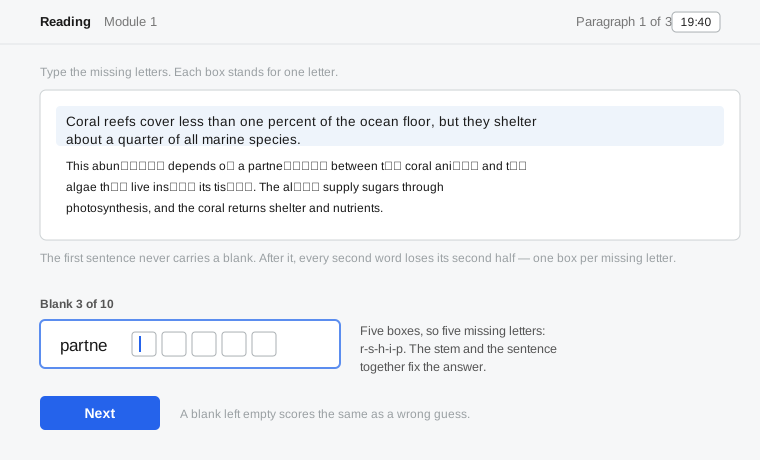
You type the missing letters directly into the gap, and the number of underscores tells you how many letters are missing.4TestSucceedTOEFL 2026 Reading Task 1: Complete the WordsOpen source ↗Jump to footnote There is no autocomplete, no spellcheck, and no dropdown of candidate words.5TOEFL Mock TestsTOEFL Complete the Words 2026: Vocabulary Drill GuideOpen source ↗Jump to footnote
One description in circulation disagrees with the rest. At least one 2026 breakdown describes paragraphs of 100 to 150 words with letters removed from the middle of long academic terms, giving examples like "photo_____sis" for photosynthesis.7College CouncilTOEFL 2026 Reading: Complete the Words, Read in Daily Life, and Academic PassageOpen source ↗Jump to footnote Every other source, and the format ETS borrowed this task from, describes the positional rule above (words removed by their position, not their difficulty). Prepare for that rule, because if you can handle it you can handle the other version anyway.
What Complete the Words really tests
This task is a C-test, a testing tool that language researchers have used since the early 1980s. The Georgetown University assessment center defines it as "a paragraph-length text in which the second half of every second word is deleted," and describes it as tapping "vocabulary, syntax, morphology, and spelling" at once, with scores that behave as "reliable measures of global language proficiency."8Georgetown University, Assessment and Evaluation Language Resource CenterC-Test Research BriefOpen source ↗Jump to footnote (Syntax is sentence grammar; morphology is how words change form.) The idea behind it is that written English gives more clues than a fluent reader actually needs, so removing half of them separates people who process English automatically from people who have to work each word out.8Georgetown University, Assessment and Evaluation Language Resource CenterC-Test Research BriefOpen source ↗Jump to footnote
ETS's own wording points the same way. The Reading claim this task sits under is the ability to "process academic written texts for meaning and form," and the CEFR evidence statements underneath include applying "basic spelling and word form knowledge to complete predictable gaps in sentences" and using "morphological and syntactic cues to infer missing words or phrases."1ETS OfficialTOEFL iBT Test: 2026 Update Test Blueprint and Specifications DocumentOpen source ↗Jump to footnote Form and spelling are named in the official skill description, not treated as a side detail.
The practical consequence follows from words being removed by position. They are cut because of where they sit in the paragraph, not because they are difficult, so your ten blanks are close to a random sample of ordinary English. In a typical paragraph that means several of them are function words (small grammar words like the, of, and) and word endings like -ed or -s, and only two or three are content words (nouns, verbs, adjectives that carry the meaning) that make any real vocabulary demand. A test-taker who prepares by memorizing academic word lists has prepared for about a quarter of the task.
How Complete the Words is scored
Every blank is machine scored. ETS defines machine-scored item types as ones evaluated by "rule-based algorithms" on selected responses, "based on exact matches or predefined scoring logic," so nothing here is judged the way an AI judges your Speaking and Writing.1ETS OfficialTOEFL iBT Test: 2026 Update Test Blueprint and Specifications DocumentOpen source ↗Jump to footnote Each blank is worth a maximum of one point, and there is no partial credit.9ArnoTOEFL Complete the Words: Complete Guide (TOEFL 2026 New Format)Open source ↗Jump to footnote
Exactness is the whole story. A word that is right in meaning but wrong in form scores zero, so if the gap needs studied and you write studying, you get nothing for it.9ArnoTOEFL Complete the Words: Complete Guide (TOEFL 2026 New Format)Open source ↗Jump to footnote A spelling slip does the same.9ArnoTOEFL Complete the Words: Complete Guide (TOEFL 2026 New Format)Open source ↗Jump to footnote Default to American spellings, since those are the conventions the test is written in.5TOEFL Mock TestsTOEFL Complete the Words 2026: Vocabulary Drill GuideOpen source ↗Jump to footnote There is no penalty for a wrong answer, which makes an empty box the one genuinely wasteful thing you can do on this task.10PrepDrillsTOEFL Reading 2026: Question Types, Timing, PracticeOpen source ↗Jump to footnote4TestSucceedTOEFL 2026 Reading Task 1: Complete the WordsOpen source ↗Jump to footnote
Two numbers in the ETS blueprint are worth putting side by side: Reading has 50 items but only 35 raw points, because item totals include non-scored questions that exist to gather data for future test versions.1ETS OfficialTOEFL iBT Test: 2026 Update Test Blueprint and Specifications DocumentOpen source ↗Jump to footnote Some of the blanks you fill will not count, and you cannot tell which, so treat all thirty as live. Your correct answers, together with the difficulty of the module you were routed into, produce a Reading band from 1.0 to 6.0 in half-point steps aligned to the CEFR, and the overall score is the average of the four section bands.11ETS OfficialTOEFL Score Scale UpdateOpen source ↗Jump to footnote
The strategy, step by step
Read the intact first sentence twice
It is the one sentence guaranteed to have nothing missing, and it exists to give you the topic. Reading it twice costs five seconds and it is what lets you resolve gaps later in the paragraph where the stem alone is ambiguous. Then read the rest of the paragraph through once without typing, saying "blank" in your head at each gap. You are building the meaning of the paragraph first, because most gaps are decided by the sentence around them rather than by the letters in front of them.
Name the part of speech before you look at the letters
For each gap, ask what job the missing word is doing: subject, verb, preposition, connector, modifier. Grammar constrains the answer harder than meaning does. A gap after "depends" with a single missing letter and the stem "o" has exactly one plausible answer, and you get there through syntax without thinking about vocabulary at all.
Take the function words first, in any order
The deletion rule guarantees a supply of easy blanks: articles, prepositions, pronouns, auxiliaries, common connectors. Fill every one of those on your first pass, in whatever order you spot them, and leave the content words for a second pass. This banks points early and, more usefully, each function word you restore makes the surrounding sentence more readable for the harder gaps nearby.
Use the letter count as a check, not as a starting point
The gap tells you how many letters are missing.4TestSucceedTOEFL 2026 Reading Task 1: Complete the WordsOpen source ↗Jump to footnote Guessing from letter count alone produces confident nonsense, so decide the word from context and grammar, then check that its ending has the right number of letters. When the count does not match, you usually have the right root with the wrong ending: require against required, analysis against analyses.
Say the full word before you type the ending
Most misses are not comprehension failures, they are spelling failures on a word the test-taker knew. Before typing, run the whole word in your head and check it against the family it belongs to: whether the suffix is -tion or -sion, -ence or -ance, -able or -ible; whether a final consonant doubles before -ed; whether a silent e drops before -ing; whether a final y becomes -ies.5TOEFL Mock TestsTOEFL Complete the Words 2026: Vocabulary Drill GuideOpen source ↗Jump to footnote Those five patterns cover most of what the task can throw at you.
Give any stuck blank eight seconds, then guess and move
A blank you cannot see in eight seconds is unlikely to come to you in thirty, and the time comes out of the rest of the module rather than out of this paragraph.10PrepDrillsTOEFL Reading 2026: Question Types, Timing, PracticeOpen source ↗Jump to footnote Type your best guess, keep moving, and come back if the paragraph is finished with time left. Budget roughly two minutes for a full paragraph; published estimates range from about 70 seconds to three minutes, and two minutes fits the section's overall timing without rushing.5TOEFL Mock TestsTOEFL Complete the Words 2026: Vocabulary Drill GuideOpen source ↗Jump to footnote4TestSucceedTOEFL 2026 Reading Task 1: Complete the WordsOpen source ↗Jump to footnote
Common mistakes and how to fix them
Preparing with academic vocabulary lists. Words are removed by position, so difficulty is not what puts a word in a gap. Fix it by shifting most of your study time to spelling patterns and word endings, and keep vocabulary work for Read an Academic Passage, where it actually pays.
Right word, wrong form. Singular for plural, present for past, noun for adjective. The machine scorer accepts one string, so a form error is a total loss on that blank.9ArnoTOEFL Complete the Words: Complete Guide (TOEFL 2026 New Format)Open source ↗Jump to footnote Fix it by reading the completed sentence back with your answer in place, which catches agreement and tense errors that reading only the word does not.
British spellings. Analyse, behaviour, centre, and organisation score zero against American keys.5TOEFL Mock TestsTOEFL Complete the Words 2026: Vocabulary Drill GuideOpen source ↗Jump to footnote Fix it by listing the twenty or so words you personally spell the British way and drilling only those, rather than trying to relearn a whole convention.
Camping on one blank. Spending forty seconds on a single gap is the most expensive mistake available on this task, because Reading is adaptive and the router decides which second module you get.1ETS OfficialTOEFL iBT Test: 2026 Update Test Blueprint and Specifications DocumentOpen source ↗Jump to footnote10PrepDrillsTOEFL Reading 2026: Question Types, Timing, PracticeOpen source ↗Jump to footnote Fix it with a hard personal limit and a guess.
Typing before reading. Filling gaps left to right as you first meet them means solving each one with only the words before it, when half the information is in the words after it. Fix it by making the no-typing read-through a rule you never break, even when the first gap looks obvious.
An example
Here is a paragraph of the length and shape you should expect, with the rule applied from the second sentence onward. Each ☐ stands for exactly one missing letter, so the number of boxes after a stem is the number of letters you owe it.
Coral reefs cover less than one percent of the ocean floor, but they shelter about a quarter of all marine species. This abun☐☐☐☐☐ depends o☐ a partne☐☐☐☐☐ between t☐☐ coral ani☐☐☐ and t☐☐ algae th☐☐ live ins☐☐☐ its tis☐☐☐. The al☐☐☐ supply sugars through photosynthesis, and the coral returns shelter and nutrients.
Count what you are actually being asked for. Of the ten gaps, two are the word the, one is on, and one is that, which is four points available to anyone who reads the sentence as a sentence. Two more, inside and animal, are ordinary words. Only abundance, partnership, tissue, and algae carry any vocabulary load, and the last of those is handed to you by the intact word algae three lines later.
Take them in the order the strategy suggests rather than left to right. The gap "o☐" sits between depends and a, and English gives depends exactly one common preposition, so on goes in without any thought about letters. Both "t☐☐" gaps have two missing letters and precede a noun, which makes the the only candidate. The gap "th☐☐" comes after algae and before a verb, so it is introducing a relative clause: that.
Now the content words. "abun☐☐☐☐☐" has five letters missing and follows This, which means it is a noun summarizing the previous sentence about a quarter of all marine species living on one percent of the floor. Abundance fits the meaning and the count. "partne☐☐☐☐☐" is the one where form matters most: partner would fill only one of the five boxes and leave four empty, and the sentence needs a thing rather than a person after "a," so it is partnership, with the five letters r-s-h-i-p. Notice that getting this one right required no knowledge of coral biology, only the ability to see that the slot wanted an abstract noun.
The blank most people lose here is "tis☐☐☐". Tissue is a word almost every test-taker knows and a spelling many get wrong under time pressure, which is exactly the profile of a lost point on this task.
How to study for Complete the Words
The most efficient drill for this task is one you build yourself, because the format is mechanical enough to reproduce exactly.
Make your own C-tests, three times a week, ten minutes. Take any academic paragraph of about 80 words from something you were going to read anyway. Leave the first sentence alone, then delete the second half of every second word from sentence two until you have ten gaps. Put it away for a day, then solve it. Building the gaps teaches you the rule from the inside, and solving your own paragraph a day later is a real test because you have forgotten the exact wording.
Drill spelling families, five minutes a day. Twenty words a day, cycling through the patterns that decide most endings: -tion against -sion, -ence against -ance, -able against -ible, consonant doubling before -ed, silent e before -ing, and y to -ies.5TOEFL Mock TestsTOEFL Complete the Words 2026: Vocabulary Drill GuideOpen source ↗Jump to footnote Write them by hand or type them; do not just read them, since the task requires production rather than recognition.
Do dictation twice a week. Ten sentences of academic English, written down at speaking speed from an audio source. Dictation trains spelling under time pressure, which is the exact condition this task creates, and it also feeds the Listening section.
Read the completed paragraph out loud. After solving any practice paragraph, read the restored version aloud. Errors of form that your eye accepts are usually caught by your ear.
Across three weeks, spend week one untimed, aiming for nine out of ten with every miss written down. In week two, add a two-minute clock per paragraph and keep an error list with three buckets: vocabulary gap, wrong form, spelling slip. From week three, stop practicing this task in isolation and run mixed Reading modules alongside Read in Daily Life and academic passages, since the real section switches between them without warning.
That three-bucket list is also how you grade yourself without an AI. The mix tells you what to fix: mostly spelling slips means drill the families harder, mostly wrong forms means slow down and read the sentence back, and mostly vocabulary gaps means your reading volume is the constraint rather than your test technique.
How to practice Complete the Words on FluentPrep AI
Our Complete the Words practice paragraphs follow the ETS shape: 70 to 100 words of academic prose, an intact first sentence, and exactly ten blanks generated by the positional rule rather than hand-picked for difficulty. Each gap shows the visible stem followed by one box per missing letter, so you get the same letter-count signal the real screen gives you, and typing is case-insensitive so capitalization never costs you a point. When you press Check Answers, every wrong blank is marked and its correct completion is revealed next to what you typed, which is the moment to classify the miss into one of the three buckets before you move on. Scores are tracked per paragraph and across the test, and Try Again lets you rerun a paragraph cold a few days later. The practice hub has the other two Reading tasks when you want to run a mixed module.
Where to go from here
Take the last academic paragraph you read today, delete the second half of every second word starting from its second sentence, and put it aside until tomorrow. Solving a C-test you built yourself teaches the rule faster than any explanation of it, and the paragraphs waiting on the Complete the Words practice page will feel considerably less strange afterward.
Footnotes
-
ETS Official. "TOEFL iBT Test: 2026 Update Test Blueprint and Specifications Document". Accessed 2026-09-07. ↩ ↩2 ↩3 ↩4 ↩5 ↩6 ↩7 ↩8
-
ETS Official. "TOEFL iBT Test Content: A Breakdown of Test Sections". Accessed 2026-09-07. ↩ ↩2
-
TestGlider. "2026 TOEFL Reading Complete the Words: Tips to Score High". Accessed 2026-09-07. ↩ ↩2 ↩3 ↩4
-
TestSucceed. "TOEFL 2026 Reading Task 1: Complete the Words". Accessed 2026-09-07. ↩ ↩2 ↩3 ↩4 ↩5 ↩6
-
TOEFL Mock Tests. "TOEFL Complete the Words 2026: Vocabulary Drill Guide". Accessed 2026-09-07. ↩ ↩2 ↩3 ↩4 ↩5 ↩6 ↩7 ↩8
-
ETS Official. "TOEFL iBT Reading Section". Accessed 2026-09-07. ↩
-
College Council. "TOEFL 2026 Reading: Complete the Words, Read in Daily Life, and Academic Passage". Accessed 2026-09-07. ↩
-
Georgetown University, Assessment and Evaluation Language Resource Center. "C-Test Research Brief". Accessed 2026-09-07. ↩ ↩2
-
Arno. "TOEFL Complete the Words: Complete Guide (TOEFL 2026 New Format)". Accessed 2026-09-07. ↩ ↩2 ↩3 ↩4
-
PrepDrills. "TOEFL Reading 2026: Question Types, Timing, Practice". Accessed 2026-09-07. ↩ ↩2 ↩3
-
ETS Official. "TOEFL Score Scale Update". Accessed 2026-09-07. ↩