A professor has posted a question on a class discussion board, two students have already replied with opposing takes, and a 10-minute timer is counting down while you decide what to add.1 That is the Academic Discussion, the last and longest of the three writing tasks on the redesigned TOEFL 2026.2
It is the one writing task that survived from the pre-2026 test, but the way it is scored changed underneath it: an ETS automated engine now reads every response, with no human rater assigned to yours.23 Strong writers lose points here for a specific reason. They treat the box like an essay prompt, write a tidy five-sentence argument, and never engage the two classmates sitting right above the cursor. The task is not an essay. It is a reply in a conversation, and the scorer can tell the difference.
By the end of this guide you will know exactly what the screen shows, how the 0-to-5 rubric splits your score, a step-by-step routine for one post, and the drills that make this task automatic. For the whole-exam picture, including how the Writing band fits your total score, start with the TOEFL 2026 test format guide; this page covers only the Academic Discussion.
What you see on test day
Writing is the third section of the 2026 test, after Reading and Listening, and all three writing tasks together run about 23 minutes.24 The tasks go back to back, each with its own timer, and the Academic Discussion comes last with a 10-minute window.21 That timer starts the moment the question appears and covers reading, planning, and writing, so no part of the 10 minutes is handed to you separately.5
The screen shows a short thread. At the top is the professor's question, usually around 70 to 75 words and often framed as a debate with two sides.5 Below it sit two classmates' posts, each roughly 50 words, typically taking opposing positions.5 ETS describes the setup plainly: "A professor has posted a question about a topic, and some classmates have responded with their ideas."1 Your job is to add your own post to that thread. A word counter runs on screen as you type.5
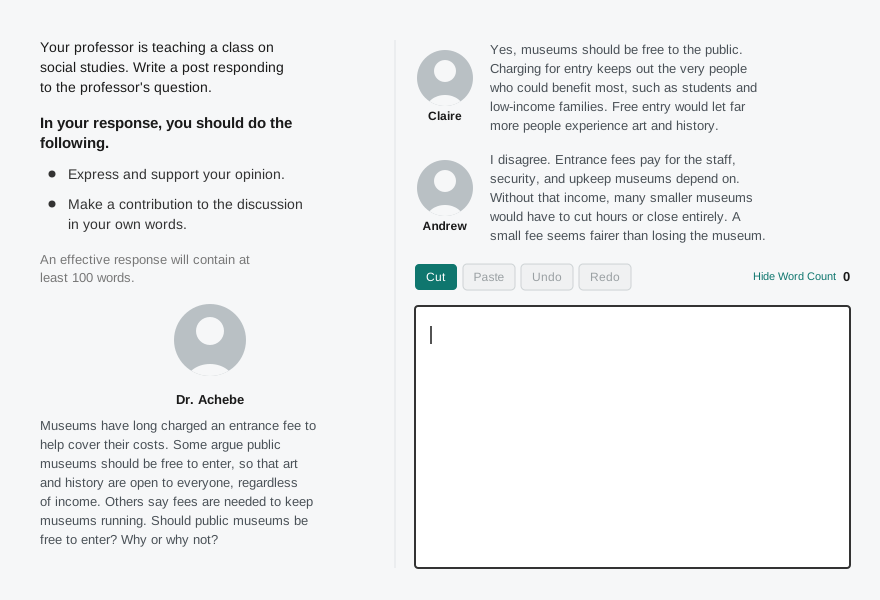
ETS frames the task as contributing "to an online classroom discussion by stating and supporting your opinion," and says it "measures your ability to develop ideas, respond to others' viewpoints, and write in an academic tone."6 The instructions above the thread are the same every time, so you never lose reading time decoding them on test day. There is no maximum length, but ETS says "a good response is usually at least 100 words."1 A blank or off-topic response can flag your whole Writing section as unscorable, so something on the professor's question always beats nothing.5
What it really tests
The surface task is "give your opinion." The skill underneath is joining an academic conversation: reading two positions quickly, deciding where you stand, and adding something the thread does not already contain. A self-contained mini-essay that ignores the two people who spoke before you is a worse answer than a rougher post that actually responds to them, because it does not do what a discussion post is for.5
Two abilities carry most of the score. The first is taking and holding a clear position. The professor's question almost always has two defensible sides, and the task rewards you for picking one and defending it, not for weighing both like a referee.4 The second is engaging the other students with substance: naming a classmate, then extending their point, qualifying it, or pushing against it with a reason of your own. Naming Marcus and adding "I agree" is engagement without contribution, and the rubric notices the gap.
The engine is also tuned to flag templated writing, so the more your post reads like a form letter you could have written before seeing the question, the more you risk.27 Aim for a post a thoughtful student would actually type into that thread.
How the Academic Discussion is scored
Your post is rated on a 0-to-5 scale.74 That task score then combines with your Build a Sentence and Write an Email scores into the Writing section band, reported from 1.0 to 6.0 in half-point steps.45 You never see the per-task number on your report; you see the section band, and one weak task pulls the average down.4
In the 2026 format the writing tasks are scored by the ETS proprietary automated engine, developed and monitored with human raters rather than sent to a rater individually.23 What matters for your prep is what that engine values, and the official rubric is built around two things: how relevant and well-developed your contribution is, and how much control you show over the language.7 The band descriptors read like this:7
| Score | What the response looks like |
|---|---|
| 5 | A relevant, very clearly expressed contribution to the discussion, with well-elaborated explanations, examples, and details, a variety of sentence structures, precise word choice, and almost no errors. |
| 4 | A relevant contribution; the language is comfortable enough that your ideas are easily understood, with only minor slips. |
| 3 | A mostly relevant and mostly understandable contribution, with some control of language but noticeable lapses in clarity or development. |
| 2 | An attempt to contribute, but limited language makes the ideas hard to follow. |
| 1 | An ineffective attempt; language limits keep the ideas from coming through. |
| 0 | Blank, off topic, copied from the prompt, or not in English. |
Three things about this scorer are worth holding onto. Relevance and development sit at the top: a post that clearly answers the professor and backs its claim with a specific example outscores a grammatically flawless post that stays vague.7 Engagement with the thread is baked into "relevant contribution," which is why responses that ignore the classmates commonly land at 3 or below even with strong English.5 And the engine does not fact-check, so your reasons, examples, names, and statistics can be invented freely; concrete invented detail reads as natural and gives the scorer more real language to reward than a true but vague sentence does.5
The strategy, step by step
Ten minutes is enough to write a developed, relevant post if you spend the first two minutes reading and deciding instead of typing. Here is the routine.
Read the professor's question as a yes/no fork
The question almost always sets up two sides. Before you read the students, decide which side you can argue with a concrete example fastest, not which side you personally believe.4 Your job is to defend a position for eight minutes, so pick the one you have material for. Spend about 30 seconds here.
Read the two posts for a hook, not a summary
Skim the classmates for one specific idea you can react to: a claim you can extend, an assumption you can question, or an example you can counter. You are not summarizing both posts; you are looking for the single point that gives your response somewhere to attach.5 Note the name attached to it.
Open with your position in the first sentence
State your side directly: "I'm with Sofia on this one: universities should let students choose their own electives." No warm-up, no "This is a very interesting question," no restating the prompt.4 The scorer, like the professor, should know where you stand by the end of sentence one, and a hedged opening that leans both ways costs you the clearest points on the rubric.
Engage the classmate by name, then go past them
Reference the student whose point you hooked, and add something. Agreeing and extending ("Marcus is right that shared classes build community, and I'd go further: they also...") or disagreeing and countering ("Marcus argues X, but that overlooks...") both work. What does not work is naming them and stopping there. The move that earns credit is the sentence after the name.
Develop one reason with a concrete example
Pick a single reason for your position and give it a specific, believable example: a named situation, a number, a short story from "my own experience."7 One reason developed fully beats two reasons mentioned briefly, because the rubric rewards elaboration, not coverage. This is where most of your words should go, landing you naturally in the 120-to-130-word range.5
Save the last minute to proofread
Stop writing with about a minute left and read the whole post once. Hunt the errors that cost most: a slipped verb tense, a subject-verb disagreement, a wrong word, a sentence that lost its thread. There is no spell-checker in the box, so this pass is the only cleanup you get.5 Confirm you took a side, named a classmate, and gave one real example before you submit.
Common mistakes and how to fix them
Summarizing the classmates instead of adding to them. You restate what both students said, agree politely, and never contribute your own idea. This reads as filler and caps your relevance score.54 Fix it by making the sentence after any classmate's name a new claim, example, or objection, not a paraphrase.
Sitting on the fence. Writing "both students make good points, and it depends on the situation" feels safe and scores badly, because the task rewards a defended position.4 Commit to one side in the first sentence and argue it, even if you privately see merit in both.
Using a memorized template. Canned openers and rigid frameworks are exactly what the AI engine is trained to detect, and heavily templated posts get marked down.27 Learn a flexible structure (position, engagement, developed reason) rather than fixed sentences you paste in unchanged.
Copying the students' wording. Lifting phrases from the classmates' posts to pad your response adds no new language for the scorer to reward and can drag a response toward the bottom of the scale.5 Put every idea in your own words.
Staying too vague. "There are many benefits and it helps students in various ways" tells the scorer nothing. Specific, invented detail ("in my first year, a required statistics course ended up shaping my whole major") reads as a real contribution and gives the engine concrete language to grade.7
Writing under 100 words. Short posts cannot develop a reason or engage a classmate, and they routinely score low.15 If you finish at 80 words with time left, add a sentence of example, not a sentence of summary.
A worked example
Here is a realistic thread in the format shown on screen.
Professor Adeyemi: Some universities require students to take a range of courses outside their major, while others let students focus almost entirely on their chosen field. Should universities require students to take courses outside their major? Why or why not?
Marcus: I think requirements are a waste of time. I came to university to study engineering, and being forced to take an art history class just slows down my real work and raises my costs. Let students specialize.
Sofia: I disagree. The point of a university is a broad education, not job training. Courses outside your major teach you to think in new ways, and you often discover interests you never knew you had.
Decide the side you can support fastest. Sofia's position comes with an easy concrete example, so build on her. Take a clear stance, name her, push past her point with your own reason, and develop it:
I'm with Sofia here: universities should require some courses outside the major, though I'd defend it on different grounds. Marcus treats an outside course as pure delay, but that assumes the skills never transfer. They often do. In my second year as a computer science student, a required public-speaking course felt like a distraction, until I had to present a project to a room of managers during an internship and realized it was the most useful class I had taken all year. A student who only ever studies code can build good software but struggle to explain it, and explaining it is half the job. A few required courses are not lost time; they cover the gaps your major leaves behind.
That is about 125 words. Look at what it does. The first sentence commits to a side and signals that a new argument is coming. It names Marcus to challenge his assumption, not to summarize it, and sides with Sofia while adding a reason she did not raise. The body then spends most of its words on one developed idea, transferable skills, carried by a specific example: the public-speaking course and the internship. That example is invented, and the scorer never checks. What earns the top band is that every sentence is doing a job the rubric rewards, with nothing left over for filler.
How to study and practice for this task
The skill is writing a developed, relevant post fast, and it grows from doing exactly that on a timer, not from studying grammar in isolation. One post takes 10 minutes, so a real session is short.
The main drill is one timed post a day. Take a discussion prompt, set a 10-minute timer, and write 120 to 130 words that state a position, engage one classmate by name, and develop one reason with a specific example, ending with a one-minute proofread. Grade each post against a single target that rotates by day rather than everything at once: Monday you only check the opening stance, Tuesday only the engagement move, Wednesday only the depth of your example. Isolating one weakness at a time fixes it faster.
A second drill sharpens the engagement move specifically, which is where most points are won and lost. Take any opinion prompt, write two versions of the classmate-response sentence: one that agrees and extends, one that disagrees and counters. Five minutes of this a few times a week trains you to react to a post with substance instead of a paraphrase.
A three-week outline that fits a normal schedule:
- Week 1: position and structure. One timed post a day. Force yourself to commit to a side in the first sentence and check only that. Ignore style for now.
- Week 2: engagement and development. Keep the daily post, but grade two things: did you push past a classmate's point with a new idea, and did you develop one reason with a real example rather than two thin ones.
- Week 3 onward: speed and stamina. Cut planning to under two minutes. Twice this week, write an Email and a Discussion back to back, since the real section runs three writing tasks in a row and the Discussion comes when you are already tired.
To self-evaluate without an AI grading you, read each post aloud and ask four questions: is my position clear by the end of the first sentence; did I name a classmate and add something new; did I develop one reason with a specific example; is it over 100 words and free of obvious errors. Reading aloud catches vague sentences and grammar slips faster than reading silently.
How to practice this on FluentPrep AI
The Academic Discussion practice mode runs the task in test format: the professor's question, two classmates' posts, a word counter, and the real 10-minute timer. Submit and you get a 0-to-5 score, a short note on each rubric area (relevance and elaboration, syntax and vocabulary, accuracy), and your post marked up in place with every fix, including relevance and cohesion flags for sentences that drift off the question:
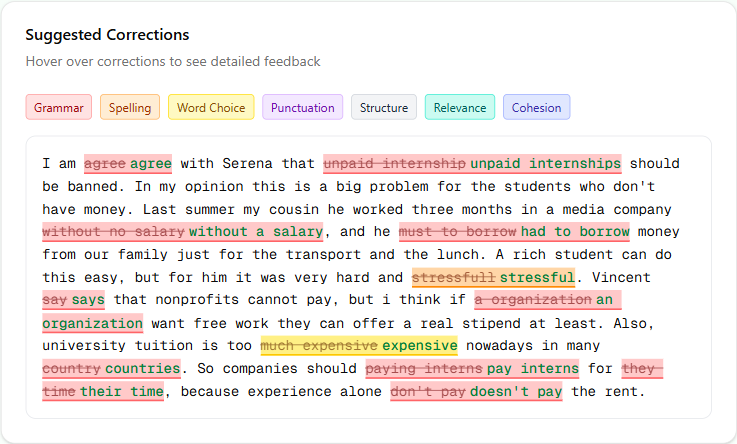
Use the fixes first, then the relevance note to catch where you summarized a classmate instead of adding something. Practice a mix of topics, and rewrite any post under 100 words or one that never named a classmate. It sits with the other eleven tasks on the practice hub.
Where to go from here
Tonight, set a 10-minute timer and answer this: your professor asks whether students learn more from working alone or in groups; two classmates have taken opposite sides. Commit to one side in your first sentence, name one classmate and push past their point, and develop a single reason with one invented but specific example. Then make a daily Academic Discussion post part of your routine, and pair it with the Write an Email task so both halves of the 2026 Writing section feel steady before test day.
Footnotes
-
ETS Official. "Writing for an Academic Discussion Task Transcript". Accessed 2026-07-01. ↩ ↩2 ↩3 ↩4 ↩5
-
College Council. "TOEFL 2026 Writing: Build a Sentence, Write an Email, and Academic Discussion". Accessed 2026-07-01. ↩ ↩2 ↩3 ↩4 ↩5 ↩6 ↩7
-
Test Resources. "2026 TOEFL Format Revealed". Accessed 2026-07-01. ↩ ↩2
-
Study.com. "TOEFL Writing Section Practice Guide 2026: Master the New Writing Tasks". Accessed 2026-07-01. ↩ ↩2 ↩3 ↩4 ↩5 ↩6 ↩7 ↩8 ↩9
-
Magoosh. "TOEFL Academic Discussion: A Complete Guide (2026)". Accessed 2026-07-01. ↩ ↩2 ↩3 ↩4 ↩5 ↩6 ↩7 ↩8 ↩9 ↩10 ↩11 ↩12 ↩13 ↩14 ↩15
-
ETS Official. "TOEFL iBT Writing Section". Accessed 2026-07-01. ↩
-
Writing30. "TOEFL Writing Rubrics 2026: Official Scoring Criteria Explained". Accessed 2026-07-01. ↩ ↩2 ↩3 ↩4 ↩5 ↩6 ↩7 ↩8