A friendly face appears on screen, thanks you for taking part in a short study, and asks what your commute to school is like. The moment the question ends, a 45-second timer starts and your microphone is live. You answer that question and three more on the same topic, and at no point do you get preparation time, a replay, or a second take.1My Speaking Score'Interview' Task in TOEFL Speaking 2026: What It Is and How It's ScoredOpen source ↗Jump to footnote
That is the Take an Interview task, the second half of the 2026 TOEFL Speaking section. The people it punishes most are the ones who prepared for the old test, because the legacy Speaking section handed you 15 to 30 seconds to plan every response and rewarded test-takers who could assemble a small speech in their head first.2MagooshTOEFL 2026 ChangesOpen source ↗Jump to footnote The Interview removes the planning stage entirely and grades what comes out of your mouth in real time. By the end of this guide you will know exactly what the screen shows, how the AI rubric splits your score, a repeatable shape for any 45-second answer, and the drills that make spontaneous English feel routine instead of terrifying.
The Interview sits inside the redesigned Speaking section that ETS launched on January 21, 2026.3Dr. Clive Walker, Ed.DThe New TOEFL iBT (2026): A Complete Guide to the January 21 RedesignOpen source ↗Jump to footnote For the whole-exam picture, including how the Speaking band fits into your overall score, start with the TOEFL 2026 test format guide; this page covers just this task.
What you see on test day
Speaking is the last section of the test, and it runs about eight minutes across eleven items.4ETS OfficialTOEFL iBT Test ContentOpen source ↗Jump to footnote5Study.comTOEFL Speaking 2026: Complete Practice Guide to Master the New FormatOpen source ↗Jump to footnote The first seven items are Listen and Repeat sentences; the final four are the Interview.6My Speaking ScoreTOEFL Speaking in 2026: The Ultimate GuideOpen source ↗Jump to footnote
The task opens with a short framing: you have volunteered for a research study or survey on a familiar topic, something like commuting, city life, or daily routines, and a pre-recorded interviewer will ask you about it.1My Speaking Score'Interview' Task in TOEFL Speaking 2026: What It Is and How It's ScoredOpen source ↗Jump to footnote ETS describes it as a simulated interview about academic and campus situations in which you answer questions about your experiences and opinions, with no specialized knowledge required.7ETS OfficialTOEFL iBT Speaking SectionOpen source ↗Jump to footnote The interviewer appears as a video, asks the four questions one at a time in a conversational tone, and even nods along while you respond.1My Speaking Score'Interview' Task in TOEFL Speaking 2026: What It Is and How It's ScoredOpen source ↗Jump to footnote The interviewer may speak with a North American, British, Australian, or New Zealand accent.8ArnoTOEFL Take an Interview: Complete Guide (TOEFL 2026 New Format)Open source ↗Jump to footnote
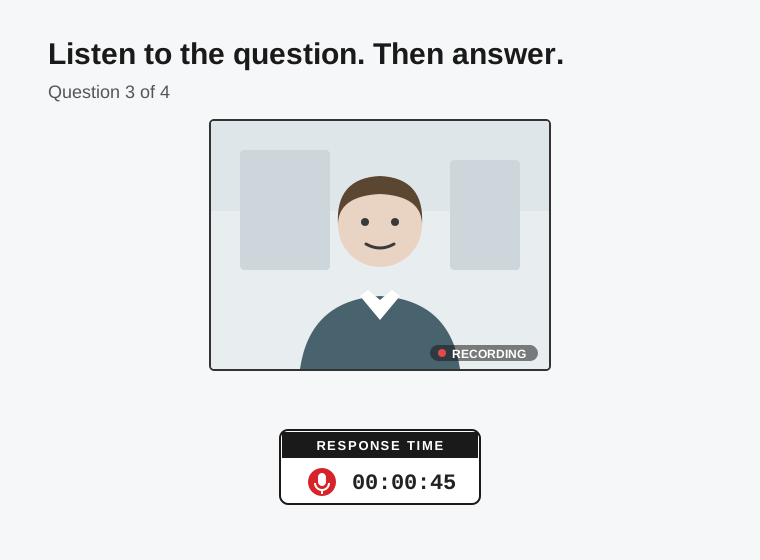
Each question plays once. When it ends, recording starts and you have up to 45 seconds to answer, with no preparation time, no repeat, and no way to re-record.1My Speaking Score'Interview' Task in TOEFL Speaking 2026: What It Is and How It's ScoredOpen source ↗Jump to footnote8ArnoTOEFL Take an Interview: Complete Guide (TOEFL 2026 New Format)Open source ↗Jump to footnote The four questions stay on one topic but climb in difficulty: the first usually asks you to recall something personal, the second asks about a preference or reaction, the third asks for an opinion you have to support, and the fourth pushes into prediction or a broader judgment.1My Speaking Score'Interview' Task in TOEFL Speaking 2026: What It Is and How It's ScoredOpen source ↗Jump to footnote9My Speaking ScoreThe New TOEFL Speaking Test (2026): Interview TaskOpen source ↗Jump to footnote So the task starts where small talk starts and ends somewhere closer to a seminar discussion, all within about three minutes.
What the Interview actually tests
Strip away the video interviewer and the task measures one thing: how well you formulate English while you are already speaking. Psycholinguists split speech production into conceptualizing what to say, formulating the words and grammar, and articulating the sounds. In your first language all three run in parallel without effort. In a second language the formulating stage is the bottleneck, and a planning window hides that bottleneck because you pre-build the sentences before the recording starts. The Interview takes the window away, so the score reflects how automatic your English actually is, which is exactly what ETS says the task measures: clear communication, a natural speaking pace, and appropriate vocabulary and grammar.7ETS OfficialTOEFL iBT Speaking SectionOpen source ↗Jump to footnote
The four-question arc raises the formulation load step by step. Recalling your commute is cheap, because the content already exists in memory and you only translate it. Defending an opinion about transit policy is expensive, because you are inventing the content and formulating the language at the same time. That climb is deliberate, and it is why test-takers sail through questions one and two and then stall on question three.
Notice what the task does not test. There is no correct answer to any question, and nobody checks whether your example really happened.8ArnoTOEFL Take an Interview: Complete Guide (TOEFL 2026 New Format)Open source ↗Jump to footnote The content of your answer is raw material for displaying language; it is graded on relevance and development, never on truth or wisdom.
How the TOEFL Speaking Interview is scored
A machine does the first-pass scoring on every 2026 Speaking response. ETS runs its automated SpeechRater engine, which transcribes your audio, extracts features like pacing, pausing, pronunciation, and word choice, and scores them against a model trained on human-rated responses, with human raters reviewing flagged answers for quality control.10ETS OfficialSpeechRater Service: Advanced Spoken-response Scoring ApplicationOpen source ↗Jump to footnote11My Speaking ScoreHow TOEFL Speaking Is Scored: The Complete Guide to TOEFL Speaking 2026Open source ↗Jump to footnote5Study.comTOEFL Speaking 2026: Complete Practice Guide to Master the New FormatOpen source ↗Jump to footnote
For the Interview, the engine evaluates four dimensions, weighted equally: fluency (pacing, smoothness, and flow), intelligibility (clarity of sounds and how much effort a listener needs), language use (grammar accuracy and vocabulary range), and organization, which includes how relevant and coherently developed your ideas are.9My Speaking ScoreThe New TOEFL Speaking Test (2026): Interview TaskOpen source ↗Jump to footnote Strong fluency and intelligibility can soften the impact of minor grammar slips, which is worth internalizing: hesitation costs you more than an article error.9My Speaking ScoreThe New TOEFL Speaking Test (2026): Interview TaskOpen source ↗Jump to footnote Tutor commentary puts the comfortable speaking rate for this task at roughly 140 to 160 words per minute, which is a relaxed conversational pace, not a sprint.9My Speaking ScoreThe New TOEFL Speaking Test (2026): Interview TaskOpen source ↗Jump to footnote
Responses are rated on a 0 to 5 rubric.12TestSucceedTOEFL 2026 Speaking Task 2: Take an InterviewOpen source ↗Jump to footnote8ArnoTOEFL Take an Interview: Complete Guide (TOEFL 2026 New Format)Open source ↗Jump to footnote Prep providers describe the granularity slightly differently: some present a 0 to 5 score per answer, while My Speaking Score describes one overall task score across all four answers.8ArnoTOEFL Take an Interview: Complete Guide (TOEFL 2026 New Format)Open source ↗Jump to footnote9My Speaking ScoreThe New TOEFL Speaking Test (2026): Interview TaskOpen source ↗Jump to footnote ETS does not publish per-item numbers either way, so the distinction never reaches your score report; what you see is the Speaking band from 1 to 6 in half steps, built from this task and Listen and Repeat together.11My Speaking ScoreHow TOEFL Speaking Is Scored: The Complete Guide to TOEFL Speaking 2026Open source ↗Jump to footnote4ETS OfficialTOEFL iBT Test ContentOpen source ↗Jump to footnote
The published rubric descriptors agree on what separates the bands:12TestSucceedTOEFL 2026 Speaking Task 2: Take an InterviewOpen source ↗Jump to footnote
| Score | What the response looks like |
|---|---|
| 5 | Fully addresses the question with clear structure and strong development. Grammar and vocabulary are accurate and varied. Easy to understand throughout. |
| 4 | Answers the question well with minor issues in connectors, pacing, or pronunciation. The message stays easy to follow. |
| 3 | Stays on topic but development is limited. Frequent pauses, repetition, or grammar limits reduce precision. |
| 2 | Attempts an answer with thin support; speech is sometimes hard to understand. |
| 1 | Minimal control of language; isolated words or memorized phrases. |
| 0 | No answer, off topic, or not in English. |
Read the 5 and the 3 rows again. The 3 is on topic and intelligible; what it lacks is development and continuity. Test-takers who plateau at the middle band are usually losing points to thin answers and long pauses, not to accent or grammar.
Two scoring behaviors deserve special attention. First, relevance is graded directly, so a fluent, well-pronounced answer to a slightly different question than the one asked still loses marks.8ArnoTOEFL Take an Interview: Complete Guide (TOEFL 2026 New Format)Open source ↗Jump to footnote Second, the engine and the human reviewers behind it both flag memorized material: long rehearsed templates produce a robotic rhythm and generic phrasing that scorers recognize and rate down on fluency.5Study.comTOEFL Speaking 2026: Complete Practice Guide to Master the New FormatOpen source ↗Jump to footnote9My Speaking ScoreThe New TOEFL Speaking Test (2026): Interview TaskOpen source ↗Jump to footnote A template promises safety but delivers the one style the system is tuned to distrust.
A strategy for every 45 seconds
You cannot plan before speaking, but you can carry a shape in. The shape that fits this task is answer, develop, finish: a direct answer in the first sentence, one developed reason with a concrete example through the middle, and a closing sentence that lands before the timer does.8ArnoTOEFL Take an Interview: Complete Guide (TOEFL 2026 New Format)Open source ↗Jump to footnote12TestSucceedTOEFL 2026 Speaking Task 2: Take an InterviewOpen source ↗Jump to footnote
Catch the question word, then answer it first
The question plays once, so listen for what kind of answer it wants: a which wants a choice, a why wants a reason, a how often wants frequency. Then make your very first sentence the direct answer: "I'd say the worst part of my commute is the transfer between buses." Opening with the answer locks in the relevance score immediately and buys your brain a few seconds of easy speech while the rest of the answer forms.
Choose the supportable answer, not the true one
When question three asks whether you agree that cities should limit cars downtown, your honest view might be complicated. Do not present it. Pick whichever side you can support fastest and treat the question as a language exercise, because that is what it is; the scorer evaluates development and clarity, not your civic convictions.8ArnoTOEFL Take an Interview: Complete Guide (TOEFL 2026 New Format)Open source ↗Jump to footnote A simple position defended with one vivid example outscores a nuanced position you cannot finish formulating.
Develop one reason with one concrete example
The middle 25 to 30 seconds belong to a single reason made specific. One real example carries an answer further than three general statements, and the difference shows up directly in the development rubric.8ArnoTOEFL Take an Interview: Complete Guide (TOEFL 2026 New Format)Open source ↗Jump to footnote "Public transport here is unreliable" is a claim. "Last winter my bus simply skipped its 7:40 run about once a week, so I started leaving 20 minutes earlier" is development: past tense, a time expression, a consequence clause, all in one breath. A specific example gives the scorer something to measure your grammar against; a general claim does not.
Keep talking to the 35 or 40 second mark
You are not required to fill the window, but tutors agree that finishing in 15 to 20 seconds wastes the chance to show your English, and the rubric has nothing to reward if you give it nothing.8ArnoTOEFL Take an Interview: Complete Guide (TOEFL 2026 New Format)Open source ↗Jump to footnote12TestSucceedTOEFL 2026 Speaking Task 2: Take an InterviewOpen source ↗Jump to footnote Train yourself to still be mid-example at 30 seconds. If you run dry early, extend the example you already gave ("and actually, that's also why I...") rather than starting a new list item.
Close with one sentence, not a fade-out
The weakest ending is a trailing "so... yeah." Spend the last five seconds on a sentence that sounds deliberate: "So overall, the transfer is annoying, but it's still better than driving." A closed answer reads as organized; one cut off mid-clause by the timer reads as unplanned even if everything before it was good.
When you slip, repair forward
Mid-sentence errors are normal in real speech, and a quick self-correction reads as ordinary fluency. Fix the word and keep going; never restart from the beginning.8ArnoTOEFL Take an Interview: Complete Guide (TOEFL 2026 New Format)Open source ↗Jump to footnote
Common Interview mistakes and how to fix them
Restarting the answer after a small mistake. This is the most commonly reported error on the task. You stumble at second eight, panic, and begin again, which spends a quarter of your window saying the same opening twice.8ArnoTOEFL Take an Interview: Complete Guide (TOEFL 2026 New Format)Open source ↗Jump to footnote The fix is a rule you set before test day: corrections move forward, never backward.
Stopping at 20 seconds. The question felt answered, so you stopped. A bare correct answer caps itself around Band 3 regardless of how cleanly it was delivered.12TestSucceedTOEFL 2026 Speaking Task 2: Take an InterviewOpen source ↗Jump to footnote9My Speaking ScoreThe New TOEFL Speaking Test (2026): Interview TaskOpen source ↗Jump to footnote Train the habit of adding the example even when stopping feels natural.
Reciting a memorized template. Long rehearsed frames ("This is a very interesting question which has many aspects...") create the robotic rhythm and generic phrasing that automated scoring identifies and rates down.5Study.comTOEFL Speaking 2026: Complete Practice Guide to Master the New FormatOpen source ↗Jump to footnote Keep at most a three-word runway like "For me, honestly..." and let everything after it be live speech.
Answering the question you hoped for. You practiced a great answer about liking your city, the question asks what you would change about it, and you deliver the practiced answer anyway. Relevance is a scored construct, so the polish does not save you.8ArnoTOEFL Take an Interview: Complete Guide (TOEFL 2026 New Format)Open source ↗Jump to footnote Listen to the entire question before forming anything.
Listing instead of developing. Three reasons in 40 seconds means each gets one shallow sentence. Signal one reason, go deep.8ArnoTOEFL Take an Interview: Complete Guide (TOEFL 2026 New Format)Open source ↗Jump to footnote
Reaching for impressive vocabulary. A rare word you half-control creates a pause before it and a pronunciation risk during it, and the rubric explicitly favors clarity over rare vocabulary.12TestSucceedTOEFL 2026 Speaking Task 2: Take an InterviewOpen source ↗Jump to footnote Use the precise ordinary word and spend your ambition on connected, flowing sentences instead.
A worked example
Suppose the topic is commuting, and question three arrives: "Some people think public transportation should be free for students. What do you think?"
Resist the urge to weigh both sides. You can support "yes" fastest, so that is your answer, and your first sentence delivers it while the rest of your thinking catches up: "I definitely think it should be free for students." That takes five seconds and secures the relevance score.
Now one reason with something real attached: "The main reason is money. Most students I know are on really tight budgets, and in my city a monthly bus pass costs about as much as a week of groceries. When my pass got discounted in my first year, I honestly went to campus more often, even just to study in the library." That middle stretch runs about 25 seconds at a conversational pace, and look at what it displays: a comparison structure, a when-clause, past tense narration, and a cause-effect link, all built from plain words.
Around second 38, close it: "So for students, I think free transport pays for itself, because people actually show up." The final sentence lands with seconds to spare and sounds chosen rather than truncated.
If "discounted" had come out garbled in the middle, the right move was to say "got cheaper, I mean" and continue. The answer would still sit comfortably in the top bands; a restart from "I definitely think..." would not have finished at all.
How to study for the Interview task
The skill under this task is automaticity, and automaticity grows from volume of spontaneous speaking, not from studying about speaking. The practice is free and needs nothing but a phone timer.
The core drill is the one-question rep: pick an everyday question, start a 45-second timer, and answer out loud with the answer-develop-finish shape, recording yourself. One rep takes under a minute, so ten minutes a day gives you eight to ten reps with playback. For material, IELTS Speaking Part 1 and Part 3 question lists are abundant online and cover the same everyday territory (habits, hometown, technology, transport) at the same two levels of difficulty, recall and opinion.
Twice a week, run a four-question ladder instead: take one topic and ask yourself a recall, a preference, an opinion, and a prediction question on it, back to back. This rehearses the exact escalation the real task uses, including the jump at question three where invention replaces memory.1My Speaking Score'Interview' Task in TOEFL Speaking 2026: What It Is and How It's ScoredOpen source ↗Jump to footnote
A three-week outline that fits around a normal schedule:
- Week 1: volume without judgment. Ten minutes of one-question reps daily. Do not review recordings yet; the goal is to make speaking-on-a-timer feel ordinary and to kill the instinct to silently rehearse first.
- Week 2: shape and clock. Keep the daily reps, but now enforce the structure: answer in sentence one, one concrete example in the middle, a closing sentence by second 43. Start listening back to one recording per day.
- Week 3 onward: review and pressure. Transcribe one answer per day, word for word, and mark the fillers, the abandoned sentences, and the grammar slips; transcription shows you your speech the way the scoring engine sees it. Add the four-question ladder and pair it with Listen and Repeat practice so you rehearse the full Speaking section sequence.
Self-evaluation without an AI comes down to four questions about each recording:
- Did the first sentence answer the question?
- Was I still talking at 35 seconds?
- Did I include one specific example?
- Could a stranger follow it on a single listen?
Playing the recording at 1.25x speed is a cheap stress test; anything that sounds mushy at that speed is what a scorer will struggle with too.
How to practice the Interview on FluentPrep AI
The Interview practice mode runs the task in test format: you pick a scenario theme, hear each question, and record into a real 45-second window that starts on a beep, with no do-overs. After the set, the AI returns a 0 to 5 score per question along with a transcription of what you said and feedback on content, fluency, pronunciation, and vocabulary, plus an overall score for the interview. Read the transcription cold and you will see your fillers, abandoned clauses, and repeated pet phrases the way the scoring engine receives them. Focus on the third and fourth questions of each scenario, since opinion and prediction answers are where development thins out, and treat any answer that ended before 30 seconds as a redo regardless of its score. The mode lives alongside everything else on the practice hub.
Where to go from here
Tonight, set a 45-second timer and answer one question out loud: "What is the best part of your daily routine, and why?" Record it, play it back, and check it against the four self-evaluation questions above. Then make that a daily habit and run a scenario on the Interview practice mode at the end of each week to measure the change. When this task feels steady, train the other half of the section with the Listen and Repeat guide, where the challenge flips from inventing language to holding it in memory.
Footnotes
-
My Speaking Score. "'Interview' Task in TOEFL Speaking 2026: What It Is and How It's Scored". Accessed 2026-06-12. ↩ ↩2 ↩3 ↩4 ↩5 ↩6
-
Magoosh. "TOEFL 2026 Changes". Accessed 2026-06-12. ↩
-
Dr. Clive Walker, Ed.D. "The New TOEFL iBT (2026): A Complete Guide to the January 21 Redesign". Accessed 2026-06-12. ↩
-
ETS Official. "TOEFL iBT Test Content". Accessed 2026-06-12. ↩ ↩2
-
Study.com. "TOEFL Speaking 2026: Complete Practice Guide to Master the New Format". Accessed 2026-06-12. ↩ ↩2 ↩3 ↩4
-
My Speaking Score. "TOEFL Speaking in 2026: The Ultimate Guide". Accessed 2026-06-12. ↩
-
ETS Official. "TOEFL iBT Speaking Section". Accessed 2026-06-12. ↩ ↩2
-
Arno. "TOEFL Take an Interview: Complete Guide (TOEFL 2026 New Format)". Accessed 2026-06-12. ↩ ↩2 ↩3 ↩4 ↩5 ↩6 ↩7 ↩8 ↩9 ↩10 ↩11 ↩12 ↩13 ↩14
-
My Speaking Score. "The New TOEFL Speaking Test (2026): Interview Task". Accessed 2026-06-12. ↩ ↩2 ↩3 ↩4 ↩5 ↩6 ↩7
-
ETS Official. "SpeechRater Service: Advanced Spoken-response Scoring Application". Accessed 2026-06-12. ↩
-
My Speaking Score. "How TOEFL Speaking Is Scored: The Complete Guide to TOEFL Speaking 2026". Accessed 2026-06-12. ↩ ↩2
-
TestSucceed. "TOEFL 2026 Speaking Task 2: Take an Interview". Accessed 2026-06-12. ↩ ↩2 ↩3 ↩4 ↩5 ↩6